Content:
The biggest issue in 2026 is not one single number — it is the interaction of tariffs, energy volatility, and materials inflation. Europe is more exposed to energy and cost-push pressure; the U.S. faces the sharper tariff-driven margin shock. Neither region is immune to both.
The Biggest Risk in 2026 Is Not Any Single Number
Tariffs are rising. Energy markets remain volatile. Material costs move within tight but policy-driven ranges. Each factor is manageable in isolation. Together, they create a pricing environment that is harder to predict, harder to absorb, and harder to recover from when your pricing systems are not built for this speed.
Welcome to the triple squeeze.
Europe is more exposed to energy and cost-push pressure. The U.S. faces the sharper tariff-driven margin shock. Neither region is immune to both.
Tariffs: The Most Immediate Shock — and It Just Changed Again
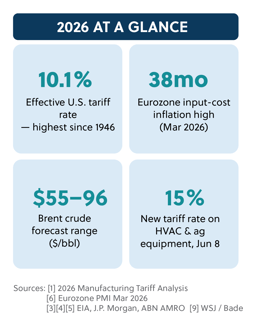
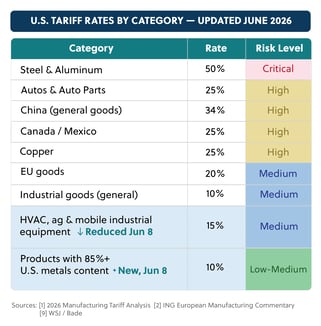
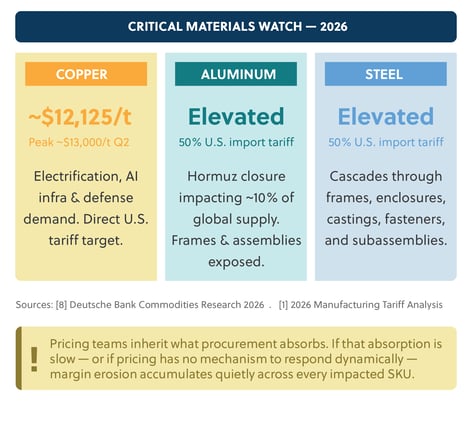
The effective U.S. tariff rate hit 10.1% in 2026, the highest since 1946. Steel and aluminum face 50% duties. Autos, auto parts, copper, Canadian and Mexican goods: 25%. Chinese imports: 34%. For European manufacturers, the pressure compounds through export friction and diverted supply flowing into EU markets. ING notes U.S. tariffs continue to undermine recovery across steel, aluminum, cars, and auto parts — while uncertainty alone is freezing capital investment decisions.
 What Changed in June 2026
On June 8, the Trump administration reduced tariffs on HVAC systems, bulldozers, forklifts, harvesters, and other mobile industrial and agricultural equipment from 25% to 15%. Products made abroad but consisting of at least 85% U.S. steel, aluminum, or copper (by weight) now qualify for a 10% rate. The relief runs through end of 2027.
The White House cited rising farm equipment, fuel, and fertilizer costs as justification. For OEMs in HVAC, construction, and ag equipment, this is meaningful near-term relief. For everyone else, it is a reminder: the tariff environment is actively managed, not settled. Monitoring is not optional. The real challenge is not identifying a tariff change. It is translating that change into pricing adjustments quickly enough that margin does not erode in the gap.
Energy: Stop Budgeting for One Number
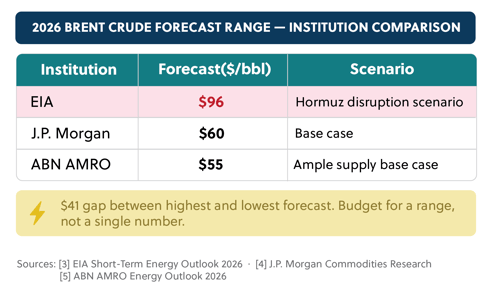
Oil is volatile in 2026, and forecasters diverge widely depending on geopolitical assumptions. Three major institutions, three very different forecasts for 2026 Brent crude. That gap is not a rounding error — it reflects genuine scenario divergence, and it means energy budgeting based on a single price point is no longer defensible.
The Hormuz closure has shaken aluminum buyers directly — the strait handles nearly 10% of global supply. Diesel has risen sharply since the U.S.-Israel-Iran conflict escalated. Energy is not just a utility cost anymore. It is a supply chain variable.
Europe faces this more acutely. Even when oil moderates, electricity- and gas-intensive operations face structural margin pressure that does not disappear with a crude price drop. Scenario-based energy budgeting — built around a range, not a single price — is the planning discipline for 2026.
Metals: When Policy Matters More Than the Spot Price
Copper, aluminum, and steel remain the most critical material-price watch items for industrial OEMs. For complex assemblies, the impact does not stay at the raw material level - it cascades through every tier of the BOM.
Two Regions. Two Pressure Profiles. One Pricing Mistake to Avoid.
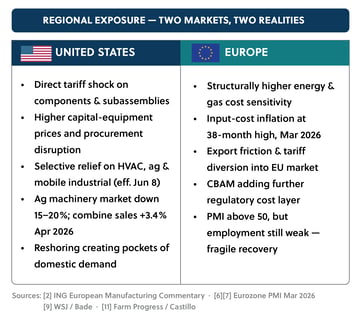
Europe and the U.S. are exposed to the same macro environment. They are not equally exposed to the same risks.
 Downstream Demand: Mixed, but Stabilization Starting
In the agricultural equipment segment, nearly 90% of dealers expect prices to increase 1–6% through end of 2026. The North American large-ag-equipment market is expected to decline 15–20% for the year. However, experts predict H2 stabilization as farmers who delayed purchases begin replacing aging fleets — combine sales rose 3.4% year over year in April 2026, an early signal that the replacement cycle is beginning.
Global pricing consistency is no longer sufficient. OEMs need regional pricing logic - where cost drivers, customer behavior and competitive dynamics differ across markets.
Building Confidence in Volatile Times
The risks in 2026 share a common thread: they reward manufacturers who can read the market faster, decide more consistently, and measure the impact of every pricing move they make.
That means three immediate priorities:
- Working capital and dual-sourcing strategies are the operational foundation. Single-source exposure to tariff-affected materials is no longer an acceptable risk.
- Scenario-based energy budgeting — built around a $55–$96 band, not a single number — is the planning discipline. Build bear, base, and bull scenarios and test your margins against each.
- Regional pricing logic, updated continuously as tariff and cost conditions shift, is where margin is protected or lost. Uniform global pricing introduces distortion, not efficiency.
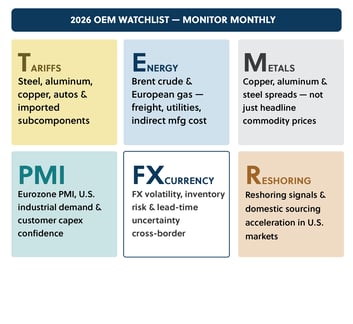
This is precisely where pricing discipline becomes a structural advantage rather than a back-office function. Machine manufacturers and OEMs that maintain real-time clarity on their markets, make pricing decisions that are traceable and consistent, and can quantify the impact of those decisions on margin — are better positioned to absorb volatility without compressing profitability.
MARKT-PILOT™ works with more than 200 machine manufacturers worldwide to build exactly this kind of operational resilience. Its unified Pricing Performance platform, MP ONE™, connects market intelligence, pricing decisions, and performance measurement in one governed system — so manufacturers can respond to what the market is doing with clarity, confidence, and control.
Clarity — real-time visibility across markets, parts, and competitors, so pricing starts from current data.
Confidence — guided, auditable pricing actions that hold up under scrutiny from customers, finance, and leadership.
Control — continuous measurement of pricing impact on margin, so performance compounds rather than resets with every market shift.
Sources
[1] 2026 Manufacturing Tariff Analysis — effective U.S. tariff rate 10.1%; 50% steel/aluminum; 25% auto & parts
[2] ING — European manufacturing commentary 2026
[3] EIA Short-Term Energy Outlook 2026 — Brent crude raised to $96/bbl
[4] J.P. Morgan Commodities Research 2026 — Brent ~$60/bbl base case
[5] ABN AMRO Energy Outlook 2026 — Brent ~$55/bbl
[6] Eurozone Manufacturing PMI, March 2026 — input-cost inflation 38-month high
[7] Eurozone Manufacturing PMI, March 2026 — macro context, interest-rate sensitivity
[8] Deutsche Bank Commodities Research 2026 — copper ~$12,125/t; Q2 peak ~$13,000/t
[9] WSJ, Gavin Bade — "Trump Lowers Tariffs on Some Heavy Metal Goods to Benefit Farmers, Others"
[10] Bloomberg, Derek Wallbank — "US Cuts Agricultural Equipment Tariffs Citing Rising Farm Costs"
[11] Farm Progress, Andy Castillo — "Farmers Delay Equipment Purchases as Machinery Costs Climb"