Content:
Somewhere right now, a pricing manager at an industrial manufacturer is updating a spreadsheet that was already wrong when they opened it. Input costs shifted last week. A competitor changed their prices three weeks ago. A regional distributor has been quietly discounting to protect volume. None of that is in the spreadsheet. And next year’s price list will be built on top of it.
The invisible costs of static pricing
For most industrial manufacturers, pricing a parts portfolio of 50,000 to one million SKUs still means annual reviews, cost-plus formulas, and a lot of gut instinct. It is a system designed for a world where markets moved slowly. That world no longer exists.
Since 2018, cost volatility in industrial value chains has increased by a factor of three to five. Price changes in many B2B markets now occur 40–60 percent more frequently than before.1) Meanwhile, B2C-level price transparency means buyers now notice when they are being overcharged, and switch accordingly. The result: manufacturers lose margin when they underprice, lose customers when they overprice, and discover which of the two happened months after the fact.

This is the Static Pricing Gap. And it is not a small inefficiency. It is a structural drag on revenue, margin, and competitive position that compounds quietly, year after year. A growing group of manufacturers have figured this out. They are not waiting for the annual price review. They are running pricing as a continuous performance discipline, and pulling away from the pack.
Pricing Performance is the discipline that separates manufacturers who profit from market volatility from those who are punished by it. It is not a technology implementation. It is not a pricing project.
It is a continuous operating capability, the ability to sense what the market is doing, decide how to respond, act with speed and governance, and measure the financial outcome. All year long. At scale.
Pricing Performance: the discipline that separates leaders
The shift in operating model looks like this:
- From static to continuous: Prices are monitored and adjusted in response to real market signals; not reset once a year and left to drift.
- From assumptions to market evidence: Decisions are grounded in uptodate competitor prices, availability, and demand (not in historical instincts).
- From list price to net price: Focus moves from nominal list prices to realized net price across regions, channels, and customer segments.
- From projects to system: Pricing becomes a governed, scalable operating capability with clear accountability and full traceability — not an occasional cleanup exercise.
Manufacturers who build this capability stop treating market volatility as a problem to survive. They start treating it as an opportunity to capture margin their competitors are leaving on the table.
Introducing MP ONE: one platform, three engines, fully connected
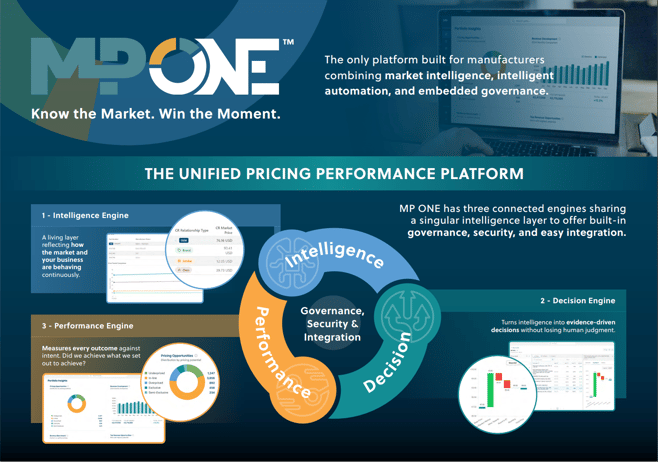
Most manufacturers today run pricing across a patchwork of ERP exports, spreadsheets, and disconnected pricing tools. Every handoff is a place where speed is lost, errors are introduced, and accountability disappears. MP ONE is MARKT-PILOT’s answer: the first unified Pricing Performance platform built specifically for industrial manufacturers. It replaces the fragmented stack with a single, unified loop from market signal to pricing decision to financial outcome. Three engines. One platform.
Fully connected:
- Intelligence Engine gives you a living, SKU-level view of what the market is actually doing right now. It unifies internal data (ERP, PLM, CRM, CPQ, sales history) with real-time external signals (competitor prices, availability, lead times, cross-references) into a single source of pricing truth. Not six months ago, today. This is what it means to "Move Faster”.
- Decision Engine turns intelligence into governed pricing action. Teams configure pricing models (cost-plus, market-based, value-based, or custom), manage price books, and execute with clear workflows, approvals, and full auditability for every list and net price. No more pricing decisions made in a vacuum. This is what it means to “Act Smarter”.
- Performance Engine closes the loop. Every pricing decision is measured against real revenue, margin, and portfolio performance outcomes in real time,
— and those learnings feed directly back into Intelligence and Decision. The system gets smarter with every cycle. This compounding data and process advantage is what it means to "Grow Stronger".
One platform. Three engines. A self-reinforcing loop from market signal to pricing decision to measured financial impact — and back again. It’s not a replacement for your pricing team. It’s the system that makes your pricing team unstoppable.
 The compounding advantage: why every quarter matters
Here is what the numbers actually look like. For every €100 Mio. in revenue under management, MP ONE typically unlocks €4–5 Mio in additional annual revenue and delivers a 13–18x ROI within the first year.2) Those are not projections or theoretical business cases. They are benchmarked outcomes from manufacturers in your industry, driven by market-based price increases, eliminated discount leakage, and better portfolio management, all governed, all traceable. And the impact scales with you: at €500 Mio revenue under management, that is roughly €20–25 Mio in additional annual revenue. The system compounds. That is the point.
Here is the dynamic that pricing leaders understand, and static pricing organizations do not: this is not a one-time investment with a static return. Every quarter on Pricing Performance, the advantage compounds. The data gets richer. The pricing models get sharper. The team builds institutional knowledge. The governance gets tighter. A competitor who starts Pricing Performance today and one who starts six months from now will not be at the same place in a year — they will be separated by six months of compounding. That gap does not shrink. It widens.
.png?width=464&height=243&name=Performance%20Engine%20(2).png) Why static pricing organizations fall behind
Why static pricing organizations fall behind
Static pricing organizations will still win deals. But quarter by quarter, they are ceding ground on margin, on customer retention, and on the institutional knowledge that pricing leaders are building into their systems. This is not a loud disruption. It is a quiet, compounding separation — and by the time it is visible, it is already very hard to close.
The question is no longer whether to build Pricing Performance as a capability. It is whether you build it before your competitors do. MP ONE gives manufacturers the platform to do exactly that.
Specifically, MP ONE delivers:
- Speed with governance: respond to market changes in days, not the next annual cycle. Continuous pricing with full auditability and accountability at every level. (Move faster: speed with control through governance).
- Evidence over instinct: replace gut-feel and historical assumptions with real competitor prices, market availability, and demand signals — at SKU level, across every market you operate in. (Act smarter: evidence-driven pricing decisions).
- Compounding returns: a platform that gets smarter with every pricing cycle, building institutional advantage that is genuinely difficult for competitors to replicate. (Grow stronger: compounding competitive advantage).
Pricing Performance is not the future of industrial pricing. It is what the leaders are already doing. The only question is whether you are building this capability now — or watching a competitor do it while you wait.
1) Sources: McKinsey, PwC, Simon‑Kucher global pricing studies; World Bank commodity markets; Eurostat and BLS industrial price data; Deloitte manufacturing outlooks (2020–2026).
2) Benchmarked across 15+ manufacturers in your industry. Actual results vary by portfolio complexity.
.png?width=984&height=515&name=260219_Blog_MP-ONE-GA_EN%20(2).png)