Content:
In theory, spare parts pricing seems straightforward: Set a list price, apply discounts, review once a year—done. In fact, it’s anything but simple.
Why? Manufacturers operate across regions, channels, and customer groups, each with their own dynamics.
They all share the same challenges:
- Local teams follow different rules
- Market conditions shift faster than pricing cycles
- Pricing becomes harder to explain—and even harder to control
This is exactly where the price waterfall comes into play.
What the Price Waterfall Reveals
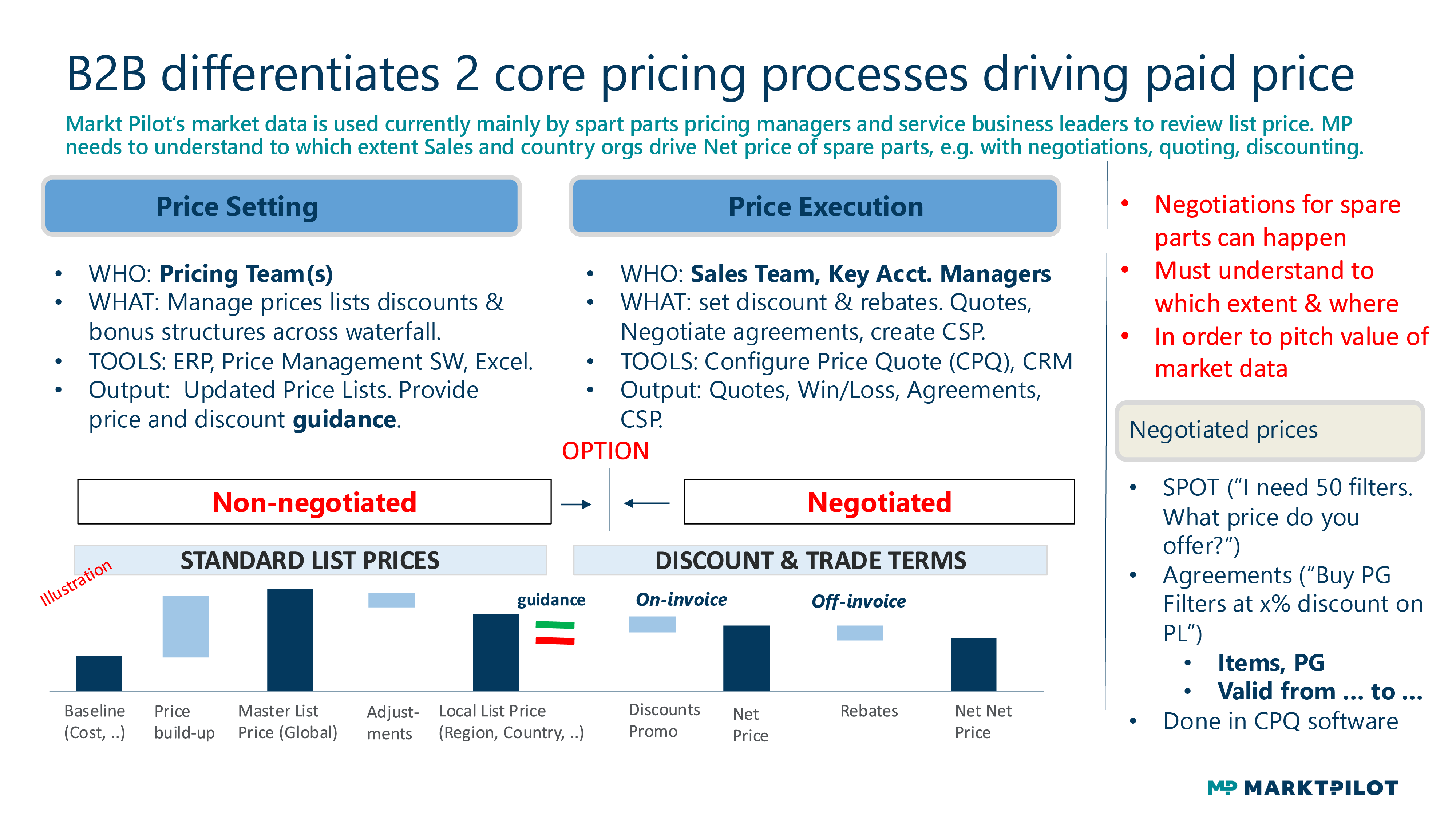
Think of the price waterfall as a transparency tool. It maps how a spare part travels from cost to final net price, step by step. It includes everything: list prices, regional adjustments, discounts, rebates, and more.
But its real value lies deeper:
- It shows where pricing decisions happen
- It reveals how prices evolve along the way
- It exposes where margins quietly disappear
In many companies, pricing is still done in silos. One team looks at the cost. Another focuses on discounts, and sales see only the final customer price. The price waterfall brings these pieces together and shows how they connect. It makes the pricing visible, and once it’s visible, it becomes easier to manage.
In other words: The price waterfall is a way to trace how a spare part moves from cost to final net price.
It covers the full path: global and local list prices, discounts, rebates, and other adjustments. Its real value lies in three key areas:
- Shows where pricing decisions are made.
- Reveals how prices are built step by step.
- Makes margin loss visible across the process.

Two Sides of One Pricing Story
At the heart of the price waterfall are two different but closely linked activities.
- Price setting: Headquarters define list prices, the logic behind them, and the rules that shape the price structure.
- Price execution: Sales teams and local entities work with customers, negotiate discounts and terms, and finally turn the list price into the actual net price (finalize deals).
The challenge is that these two worlds often move at different speeds. Headquarters may define one logic, while the market pushes in another direction. When that happens, pricing drifts. Inconsistencies are growing. And the company loses visibility over what is really happening in the field.
Where Your Margin Quietly Disappears
Across manufacturers, the same patterns keep showing up:
- Regional inconsistency: Local price lists create customer confusion across borders.
- Cost-plus without market data: Purchased parts priced too high or too low vs. competition.
- Annual blanket increases: "Plus 2-3%" creates outdated pricing structures over time.
- Strategy-execution gap: Different assumptions lead to unplanned discounts and manual fixes.
You can check your price waterfall calculator below.
 What Better Pricing Requires
Today’s spare parts pricing requires more than spreadsheets and annual updates. It needs a system.
Effective pricing is built on:
- Transparency: Everyone understands how a price is formed
- Continuous updates: Pricing reflects real market dynamics
- Simulation: Changes can be tested before rollout
- Market alignment: Prices reflect actual transaction data
- Clear ownership: Responsibilities are defined
- Traceability: Every decision is documented
Without this, pricing becomes reactive and heavily dependent on individual judgment and too little on structure.
MP ONE™: From Theory to Confidence and Control 
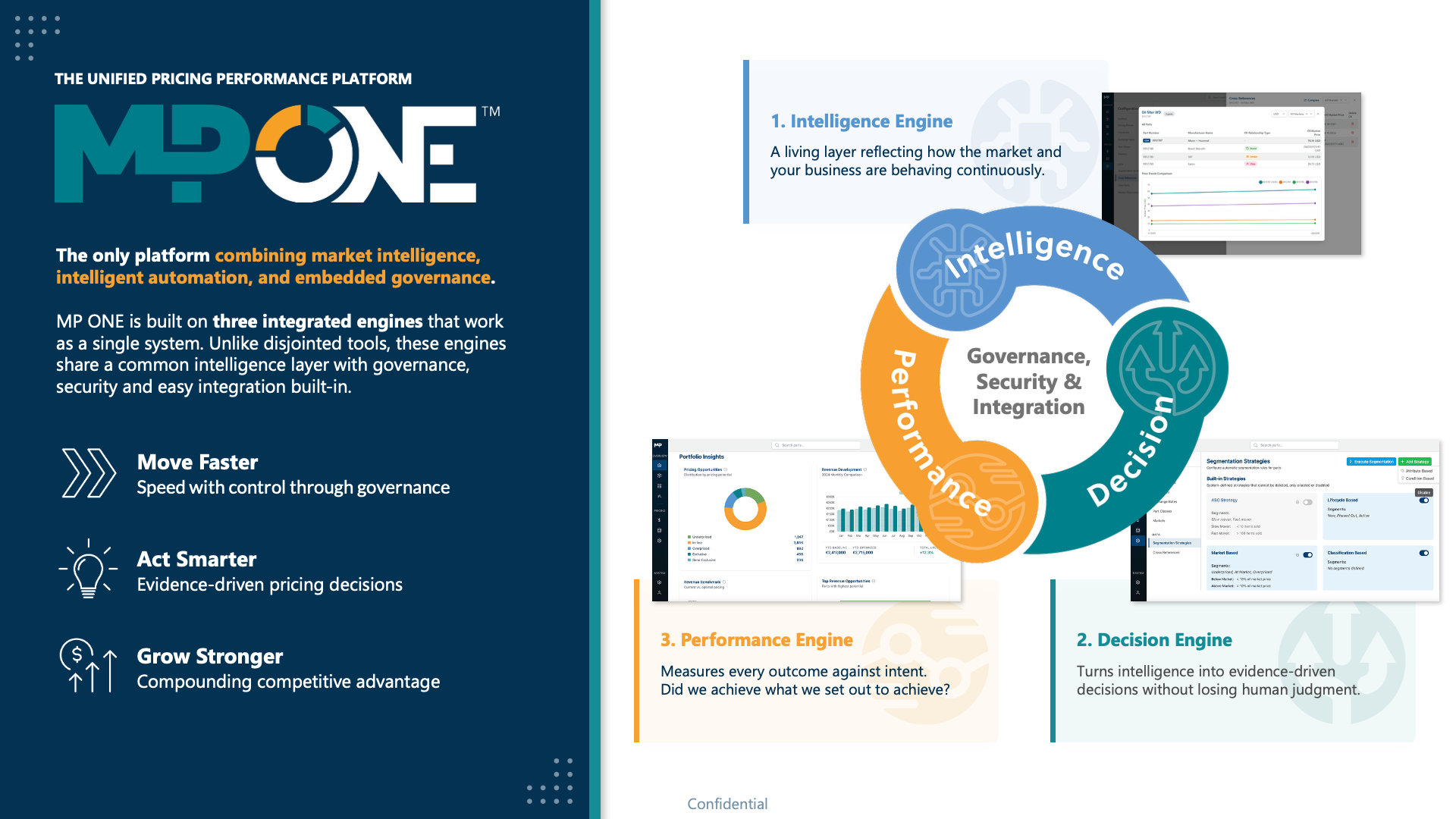
This is where MP ONE comes in as a Pricing Performance platform. It helps manufacturers turn the price waterfall into a practical management tool.
With MP ONE, the following steps or processes can be implemented:
- Pricing logic: Companies can combine cost-based, value-based, and market-based approaches. They can also include product attributes such as criticality, complexity, availability, and competitive pressure. Market data adds a further dimension by showing how similar parts are priced elsewhere and what range is realistic.
- Structure: Global, regional, country-specific, and customer-specific price books can be linked in a clear hierarchy. That means a change at one level can be reflected across the others, while local teams still retain room for market-specific decisions.
- Market integration: Market data should not sit outside the process as a separate reference. It should shape the actual pricing decision. That makes it easier to see whether a price sits above or below the market, and when a part should intentionally be priced outside the middle of the market because of its value or role.
- Testing and measurement: Before a new price list goes live, teams can work through scenarios. What happens if a rule changes? Which products move out of line? Does the new logic improve margin? Later, transaction data can show whether the updated waterfall delivered better results.
And finally, it supports the explanation. Sales and service teams need to answer customer questions. That is easier when the logic behind the price is visible. It also helps internal discussions stay grounded in facts rather than assumptions.
 What This looks Like in Practice
In many manufacturing companies, the same use cases keep surfacing.
- Traceability: Companies increasingly want to know who changed which rule, which list was updated, and on what basis. That kind of documentation creates clarity and makes pricing decisions easier to review, explain, and defend.
Why the Waterfall Still Matters
Most manufacturers understand the price waterfall in principle. The real challenge is managing it as a living process rather than a static model. Without transparency, market data, and a platform that connects logic, ownership, and simulation, pricing remains fragmented and reactive.
A Pricing Performance platform such as MP ONE turns the price waterfall into an operational tool. It brings list prices, discounts, market prices, and transaction data together in one system.
That does not just support margins. It also creates consistency, traceability, and trust in a market where pricing is under increasing scrutiny.
Closing Perspective
My key takeaways for you: Spare parts pricing isn't getting any easier—in fact, it's getting tougher as markets turn transparent, and customers expect consistency. The winners aren't the companies with endless rules. They're the ones with crystal-clear visibility across their entire pricing chain. That's the real power of a well-managed price waterfall—and where a pricing-performance platform like MP ONE draws the line between reactive firefighting and pricing you actually control.
Stefan Sandulescu is Senior Solutions Engineer at MARKT-PILOT, helping OEMs turn spare parts into profit engines.