Event
Close the Gap. Build the Community. Lead the Market.
PARTS FORUM 2026 brought aftermarket leaders to Chicago for a record-breaking day on pricing, strategy, and industry transformation. Here’s the...
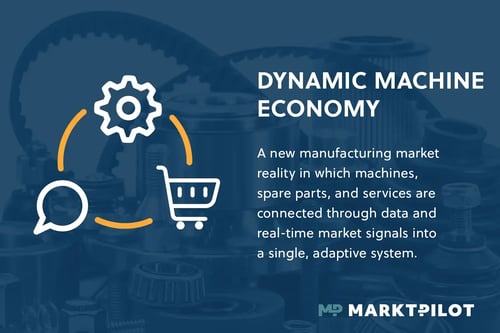
The Dynamic Machine Economy (DME) reflects today’s manufacturing reality, where markets are constantly changing and deeply interconnected. Tariffs shift without warning. Global conflicts disrupt supply routes. Input costs fluctuate. Competitors adjust pricing faster than ever. What was once predictable has become a tightly entangled system where every change influences machines, parts, and services simultaneously.
This environment, operating in silos is no longer viable. Machines, spare parts, and services must be connected through shared data and real-time market signals. Pricing can no longer be static or episodic. It must continuously adapt based on what is happening in the market. The Dynamic Machine Economy connects production and aftermarket into a single, adaptive system where it is explainable, and measurable to turn volatility into advantage.
The machinery and field services industries are shifting from predictable, static environments to markets defined by volatility, transparency, and speed. The assumptions that governed pricing and service for decades no longer hold.
✅ Prices respond instantly to market reality: Pricing adapts continuously to competitor behavior, demand shifts, and availability, not annual cycles.
✅ Aftermarket and production operate as one system: Market signals flow across the organization, aligning pricing, service, and planning decisions.
✅ Transparency accelerates decisions: Explainable intelligence replaces guesswork, enabling faster action with greater confidence.
✅ Trust becomes measurable: Data-backed decisions create internal alignment and external credibility, turning trust into a competitive asset.
IoT & Sensors: Machines are equipped with sensors that monitor their performance in real time. These sensors collect data on temperature, vibration, and wear and tear, allowing machines to "know" when something is wrong or a part needs to be replaced.
AI and Machine Learning: AI is at the heart of DME. AI algorithms analyze the data collected by machines to help them decide what and when to order and from whom. This enables dynamic pricing, risk assessment, and resource allocation.
APIs and Digital Catalogs: APIs and digital catalogs are key to enabling machines to communicate seamlessly with suppliers. These technologies allow machines to query suppliers in real time for pricing, availability, and specifications, ensuring accurate and timely transactions.
Blockchain: Blockchain ensures that all DME transactions are secure, transparent, and tamper-proof. With smart contracts, machines can interact directly with suppliers and other machines to ensure that agreements are executed and honored.
Although the full vision of DME is still a few years away, several key technologies are already being adopted by various industries.
The progression of the Dynamic Machine Economy will likely occur in phases of autonomy.
It is to highlight that DME in B2B will not be about free-for-all global markets but rather about closed, trusted ecosystems where contracts and dynamic pricing drive machine-to-machine transactions.
Machines will operate within pre-approved supplier networks, such as original equipment manufacturer (OEM) portals, distributor networks, or long-term partner ecosystems. These are not global, open marketplaces like Amazon; rather, they are private B2B marketplaces where machines interact only with trusted partners. OEMs can ensure that their parts are sold within these controlled ecosystems, which ensures quality and security while allowing for automation.
In a Dynamic Machine Economy setting, framework agreements that define payment terms, warranties, and service levels remain crucial. These agreements are encoded into APIs or smart contracts, enabling machines to operate within these parameters. This ensures that the purchasing process adheres to the predefined terms and conditions, maintaining consistency and security across transactions.
Even within a fixed network of suppliers, prices can be dynamic. AI-driven, market-based pricing models adjust prices in real time based on factors such as competitor pricing and product availability, while adhering to the established agreements' constraints. Machines will be able to select the optimal supplier from these approved options.
AI-driven market research streamlines the analysis of large datasets, such as competitor pricing, customer trends, and material costs. By automating repetitive tasks, it not only saves time but also delivers greater accuracy than common manual methods. This approach is particularly relevant to machine manufacturers aiming for market-based pricing strategies.
In the Dynamic Machine Economy, success is no longer determined by pricing tools alone. It is determined by the ability to turn intelligence into outcomes, consistently and at speed.
As markets become more transparent and volatile, manufacturers are being divided into two groups. Those who continue to rely on static pricing processes and siloed decision making struggle to keep pace. Those who adopt a new operating discipline gain a structural advantage.
Pricing Performance is emerging as that discipline. It connects market intelligence, decision support, and performance measurement into a continuous system that allows organizations to respond faster, price with confidence, and compete effectively in real time.
Organizations that master Pricing Performance move beyond reactive pricing. They continuously optimize, protect margins, uncover hidden revenue, and establish a competitive position that becomes harder to dislodge with every pricing cycle.
Those that do not fall behind.
Pricing Performance is the discipline of continuously translating market intelligence into measurable business outcomes.
It connects intelligence, what is happening in the market, with decisioning, what actions to take, and performance, what results were achieved. Together, these form a closed loop that enables learning, accountability, and continuous improvement.
In a dynamic economy, pricing leaders do not simply set prices.
They sense change as it happens.
They decide with clarity and speed.
They measure impact and adapt continuously.
This is the difference between managing prices and competing on pricing.
In the Dynamic Machine Economy, timing matters.
Early movers in Pricing Performance establish price expectations before transparency peaks. They institutionalize market intelligence while others rely on tribal knowledge and manual judgment. They build organizational muscle around continuous decision making while competitors remain reactive.
As a result, the gap widens.
Leaders compound advantage through every pricing cycle.
Laggards lose margin, speed, and relevance.
In dynamic markets, standing still is not neutral. It is a decision to fall behind.
Overview of Parts Pricing Strategies
In this article, we review a few of the most common parts pricing strategies for OEMs.
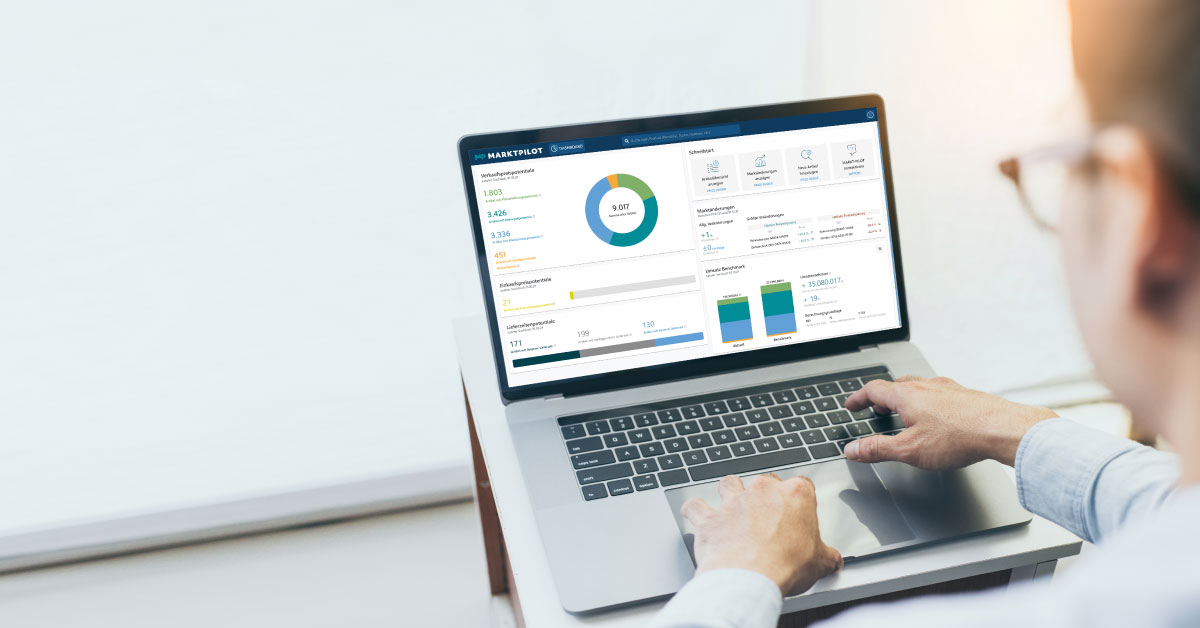
Learn how AI-powered solutions can help your company participate in the Dynamic Machine Economy. Get in touch with us to discover how AI-supported pricing performance with MARKT-PILOT can create new opportunities for your company in the machine economy.

Digitalization is reshaping machine manufacturing, challenging traditional after-sales services.
Explore real-world applications and learn how to successfully integrate AI into your operations with our essential checklist.
Integrating AI solutions allows machine manufacturers to optimize production processes, making them more efficient, accurate, and flexible.
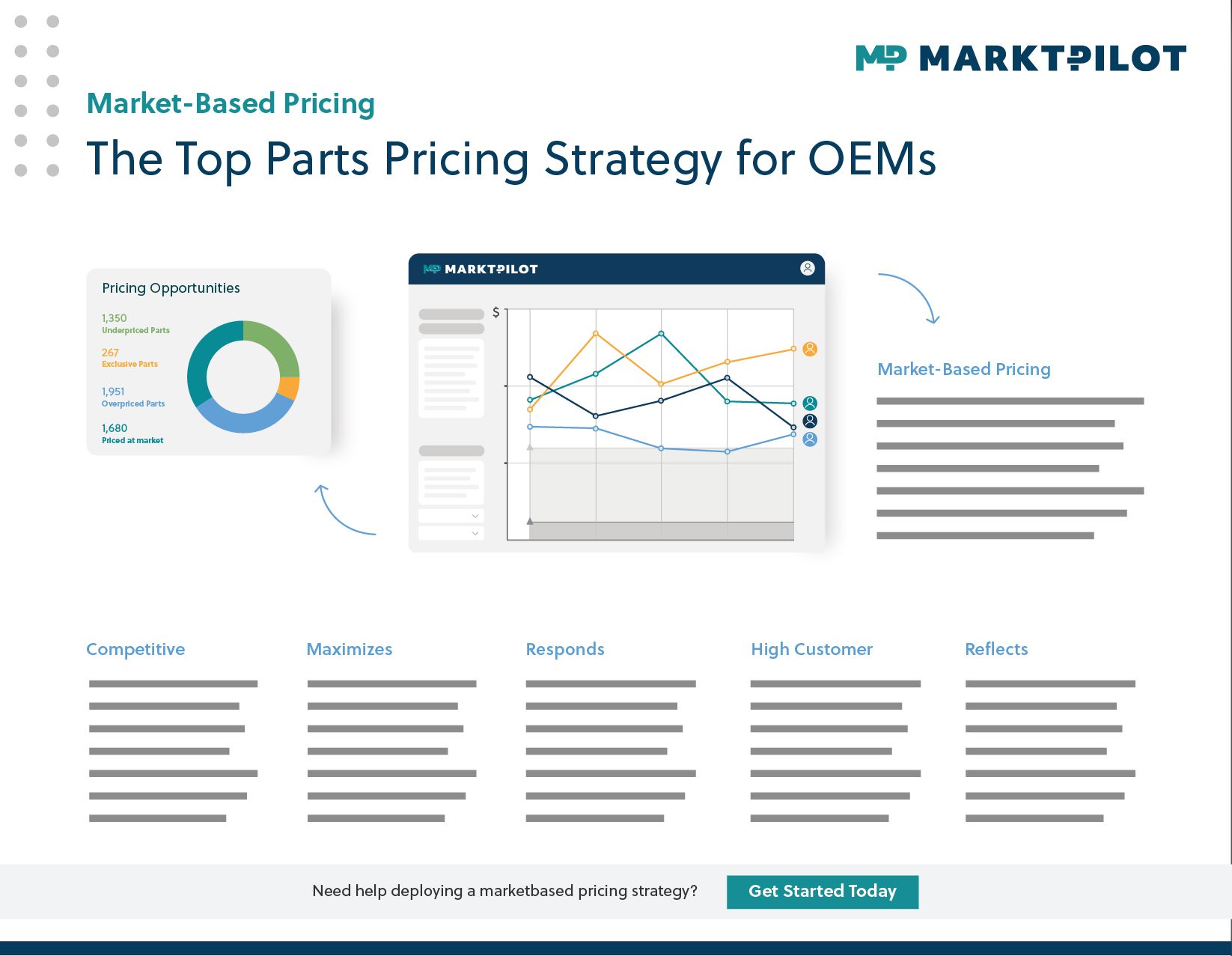
Take a deep dive into what is the top pricing strategy for OEMs and discover how it can greatly increase your revenue.
MARKT-PILOT is a leading provider of software for market-based spare parts pricing in machine manufacturing. The solutions enable OEMs to conduct precise market price research, automated price recommendations and optimized strategies. Customers benefit from increased sales, margins and customer satisfaction in their parts business.

PARTS FORUM 2026 brought aftermarket leaders to Chicago for a record-breaking day on pricing, strategy, and industry transformation. Here’s the...
Pricing Performance is the discipline of keeping every spare part price right, continuously, as the market moves. Learn what it means, why prices...
Two CEOs, one direction: Stephen Fauth and Martin Ruth on how MARKT-PILOT's Co-CEO model multiplies leadership capacity and turns customer needs into...