Content:
BAUER Maschinen, one of the world’s leading manufacturers of specialist foundation engineering equipment, has set itself an ambitious goal: to steadily grow its service and parts business through 2030. To steer this development, the company chose a pragmatic way to define its global aftermarket potential, deliberately avoiding complex academic studies and theoretical models.
From Intuition to a Solid Baseline
BAUER Maschinen is a part of the BAUER Group, which operates worldwide in three segments: Construction, Equipment and Resources, employing around 11,000 people and generating group revenues in billions. The equipment segment designs and builds rotary drilling rigs, diaphragm wall equipment and related tools, offering customers both individual machines and complete systems including service and technical support. Within this setup, “Parts & Service” has evolved into an independent, strategically important business line supported by a global network of subsidiaries, dealers and service partners.
 The project started with a clear management directive in 2018: to double global aftermarket revenue by 2025. This immediately raised key questions: Where does BAUER Maschinen currently stand in the global service business, how big is the worldwide potential and which market share is realistically achievable? At the same time, the team needed clarity on what exactly counts as service and parts, what the customer and machine base looks like, and which data is already available or still missing.
While service revenue for the central legal entity could be determined relatively easily thanks to SAP and clean order classifications, the situation in the global network of subsidiaries and partners was much more heterogeneous. Different ERP systems, booking logics and organizational structures initially made it difficult to gain a consistent view of the global service and parts business. One important step forward was the introduction of a lifecycle number for every machine, allowing revenues to be clearly assigned and classified as original equipment versus aftermarket.
When Every Foundation Contractor Becomes a Potential Customer
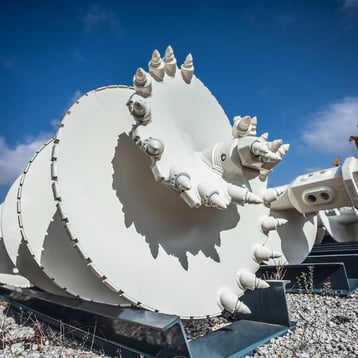
BAUER Maschinen first defined which products and services should be included in the market potential assessment. The core portfolio covers classic spare parts and service work on the machines as well as components such as winches and rotary drives. In addition, drilling tools, casings and their wear parts were included – product groups that are used not only on BAUER machines but also on equipment from other manufacturers. By doing this, the company deliberately expanded its perspective beyond its own installed base and now views all specialist foundation contractors worldwide as potential customers for its service and parts business.
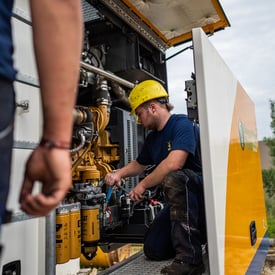
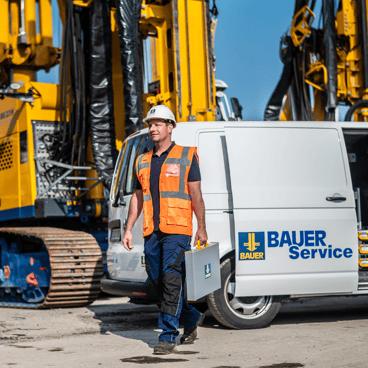 In parallel, BAUER Maschinen defined the range of services it wants to offer from traditional parts supply, repairs and overhauls through to preventive maintenance, predictive maintenance, technical consulting and on-site support. This broad portfolio reflects the ambition not only to ship components, but to secure the long-term availability and performance of the machines on customer jobsites.
Calculating a Billion Euro Potential from the Fleet
BAUER’s calculation model is built around the active global fleet of specialist foundation equipment, both its own machines and those of competitors. Internal installed-base data formed the starting point for the number of BAUER machines in the field, to which a typical utilization rate was applied. For competitor machines, the company drew market data from its own marketing organization and assumed a defined share of actively operated units as well.
For each defined product and service group, the team then projected annual demand. For parts and service, the average new machine price served as the reference, from which an annual percentage was derived as the amount typically required to keep a unit operational, backed by real operating data from a BAUER Maschinen related company active in specialist foundation construction. For drilling tools and casings, BAUER Maschinen could rely on a master’s thesis that had empirically determined the average yearly consumption per rig. Wear parts were added based on their typical usage frequency per machine and year.
The same structure was used to assess competitor equipment, but with adjusted assumptions for price levels, service intensity, and machine complexity. Lower average machine values and smaller annual percentages for parts and services were applied to reflect different market segments and pricing levels. The result was a twofold but internally consistent view of the global service and parts market in this segment of machine manufacturing: one view for BAUER machines, one for competitor equipment. Summed up, these calculations revealed a global annual aftermarket potential in the billion-dollar range.
Thinking Global, Calculating Local
In the next step, BAUER Maschinen defined realistic target market shares for each portfolio group. For its own machines, the company set ambitious but feasible targets for parts, service, drilling tools, wear parts and components; for competitor equipment, the approach was deliberately conservative and focused on drilling tools and related wear parts only. Based on these target shares, the company identified a potential that, if achieved, would effectively double the current aftermarket revenue.
 A plausibility check against the implied global market share confirmed that the model was sound: The assumed share for BAUER’s own machines was in line with what had already been achieved in established regions, while the share for competitor equipment remained in the low single-digit range.
To transform the global calculation into actionable targets for local organizations, BAUER Maschinen introduced regional adjustment factors. The key inputs include fleet utilization in the region, the share of special-purpose machines, local price levels, and the service affinity of customers. These parameters are combined into a regional revenue factor that scales the global potential down to realistic conditions in each market.
In the United States, for example, the high utilization of rigs, higher price levels and a strong service orientation among customers all flow into the calculation. The combination of installed base, per machine indicators and the regional revenue factor then yields a clear, transparent annual service and parts target for each local entity.
Data That Sharpens the Service Business
To power this approach, BAUER Maschinen relies on multiple data sources: ERP data from headquarters, the lifecycle number per machine, marketing and market data on the global installed base, as well as experience from the company’s own construction projects and from sister companies. Project-based analyses, such as academic theses or major tenders, further underpin assumptions about wear and tool demand.
At the same time, the exercise highlights where more work is needed: a consistent, standardized data layer across all subsidiaries and partners, more granular segmentation by machine type and application, and more up-to-date information on actual machine operating hours in individual markets. Digital solutions and market analytics tools help close these gaps and continuously refine the underlying assumptions.
 In this context, MARKT-PILOT plays a key role in researching price levels and competitive dynamics in the parts business. Through systematic market analysis, BAUER Maschinen gains additional insights into competitor offerings, price ranges and availability, all which flow into the assessment of its own market position. These external market intelligence complement BAUER’s internal potential calculations and support more informed decisions on pricing, portfolio depth and priorities in the aftermarket sales organization.
Pragmatism That Is Effective across the Globe
Based on the calculated market potential, BAUER Maschinen developed a standardized calculation and reporting tool and rolled it out to its subsidiaries. Local units enter their installed base, utilization figures, special machines and regional factors into the tool and receive concrete aftermarket targets in return. Bi-monthly review meetings are used to check progress, define actions and adjust targets annually in line with changes in utilization, service affinity or exceptional market situations.
Not everything went according to plan: The Covid19 pandemic and geopolitical crises forced BAUER Maschinen to extend the project timeline, adapt interim targets and launch a follow-on program through to 2030. At the same time, these disruptions also opened additional growth opportunities, as Senior Executive Director Parts & Service Walter Froehlich points out.
For Froehlich, the biggest strength of the model lies in its pragmatism. “It is easy to explain, quick to implement and accepted by our subsidiaries,” he says. Instead of aiming for mathematical perfection, the company works with a target accuracy of around 85 to 90 percent, sufficient for robust strategic decisions and effective sales steering. Another advantage is the ability to continuously refine the model with new data and experience, making it a solid foundation for expanding the service and parts business as a key driver of company revenue.
Froehlich also highlights the value of working with MARKT-PILOT on this journey. The cooperation makes it significantly easier to access relevant market data, he notes, and benefits from MARKT-PILOT’s innovative mindset and ongoing product development across all aspects of the spare parts business. Looking ahead, BAUER Maschinen plans to deepen this collaboration, particularly in the field of international pricing.
Walter Froehlich talks about the importance of data quality and the role of AI in modern spare parts pricing. Watch the video.
In this expert interview from the PARTS SUMMIT 2025, Walter Froehlich, Senior Executive Director Parts & Service at BAUER Maschinen GmbH, gives valuable insights to improve the service and parts business.