The Price Waterfall in Packaging Machinery: Where Margin Quietly Walks Out the Line
In a 4.5% growth market, pricing is the only lever left. The price waterfall is where packaging margin actually lives, and where MP ONE makes it operational.
Content:
- What the Price Waterfall Reveals for Packaging OEMs?
- Where the Margin Is Going?
- How the Waterfall Behaves on One Part?
- What a Working Waterfall Actually Needs?
- What Changes the Day You See It All?
- Stop Watching Margin Walk Out the Door
A packaging line producing pharmaceuticals at full speed carries a downtime cost an order of magnitude higher than the same line running food. Both customers buy the same forming and sealing jaw from the same price list. Your pricing treats them identically.
This is not a product problem. It is a pricing problem. And in a market growing at 4.5%, you cannot grow your way out of a margin problem. You have to price your way through it.
In 2025, U.S. packaging machinery sales reached USD 11.3 billion and PMMI projected 2.2% growth for the year. PMMI member surveys from the same period show the industry split on how to handle tariff-driven cost pressure: roughly 32% of leaders planned to pass all cost increases through to customers, 42% planned a mix of pass-through and absorbed margin, and 6% expected tariffs to have no effect on their costs. None of the three approaches answers the harder question: what survives between the list price on the invoice and the cash that actually lands in pocket.
That gap, between list and pocket, is where the 2026 P&L is being decided in packaging.
The price waterfall is where it lives.
What the Price Waterfall Reveals for Packaging OEMs?
The price waterfall is the path a part takes from list to pocket. List, distributor discount, end-market adjustment, customer rebate, off-invoice items, freight, returns. Each step is small. Each is invisible to the next one upstream. Most packaging OEMs see two numbers, the top (list) and the bottom (gross margin at year-end). Everything between is dark.
In packaging, that dark stretch has a distinct shape. The pressure is not primarily a crisis. It is structural:
- Tariff volatility that has fragmented the industry. The PMMI 32 / 42 / 6 split shows there is no consensus response. The cost is real, the strategy is fragmented, and the SKU-level margin impact is too.
- An end-user customer base that does not behave as one segment. Food and beverage account for roughly 59% of U.S. packaging machinery activity. Pharma, chemicals, personal care, and other end-users each carry different downtime cost, different price tolerance, different aftermarket pressure. Pricing a single price list across all of them leaves margin on most of them.
- An aftermarket parts business that is now central to customer retention. PMMI's 2025 trend research positions aftermarket parts and service as a primary retention driver. Yet most packaging OEMs still price aftermarket on cost-plus markup, as if it were a tail business attached to the new equipment sale.
-
A digitalization gap that delays the fix. AI and predictive maintenance are widely cited as priorities, but with limited in-house expertise and uncertain ROI, the reflex is to delay. The cost of delay shows up in margin that does not recover.
Four pressures, one waterfall. In a moderate-growth market, the packaging OEMs that hold margin are the ones that can actually see it.
Where the Margin Is Going?
You probably recognise at least three of these:
- Cost-plus pricing across a long-tail catalogue. Packaging OEM portfolios run from a few thousand SKUs at smaller manufacturers to 150,000 or more at large multi-platform groups. Manual pricing teams cannot cover that surface area at any meaningful level of granularity.
- One pricing logic for very different end-users. A sealing jaw on a high-speed food line has a different downtime cost than the same jaw on a pharma line. The same SKU. Different willingness to pay. Most packaging OEMs apply the same logic to both.
- Tariff pass-through decided once a year. The PMMI split shows the industry is trying three different strategies simultaneously. None of them work at the SKU level. None of them adjust mid-year as tariffs move.
- Aftermarket priced as an afterthought. Aftermarket parts are now the retention engine and the margin engine. They are still being priced as if they were the tail.
- A waterfall nobody owns. Corporate sets list. Sales negotiates discount. Finance reconciles off-invoice. Service and aftermarket teams operate on their own pricing tribal knowledge. Nobody watches the whole path at the SKU level, so nobody knows where the leak is. Only that it happened.
This is the gap most packaging OEMs underestimate. A packaging line running pharma carries a downtime cost an order of magnitude higher than the same line running food, plus regulatory and batch-record consequences that food customers do not face. The same line running personal care products has more aftermarket substitution options than either. Pricing the same wear part the same way across all three end-markets means you are either underpricing the pharma customer who would pay a premium for guaranteed availability, or overpricing the personal care customer who will route around you on the next replacement. Both are leaks. Both are invisible at the portfolio level. And in a 4.5% growth market, both are the difference between a year that builds the business and a year that explains why margin slipped in a stable market.
Want to see what this looks like on your own portfolio?
How the Waterfall Behaves on One Part?
A single SKU. A forming and sealing jaw on a horizontal flow wrap or vertical form-fill-seal line. High-wear, frequently replaced, line-critical across food, beverage, and pharma packaging. The same waterfall pattern shows up on cutting blades, vacuum cups, gripper assemblies, and any wear part where end-market mix drives meaningful differences in willingness to pay.
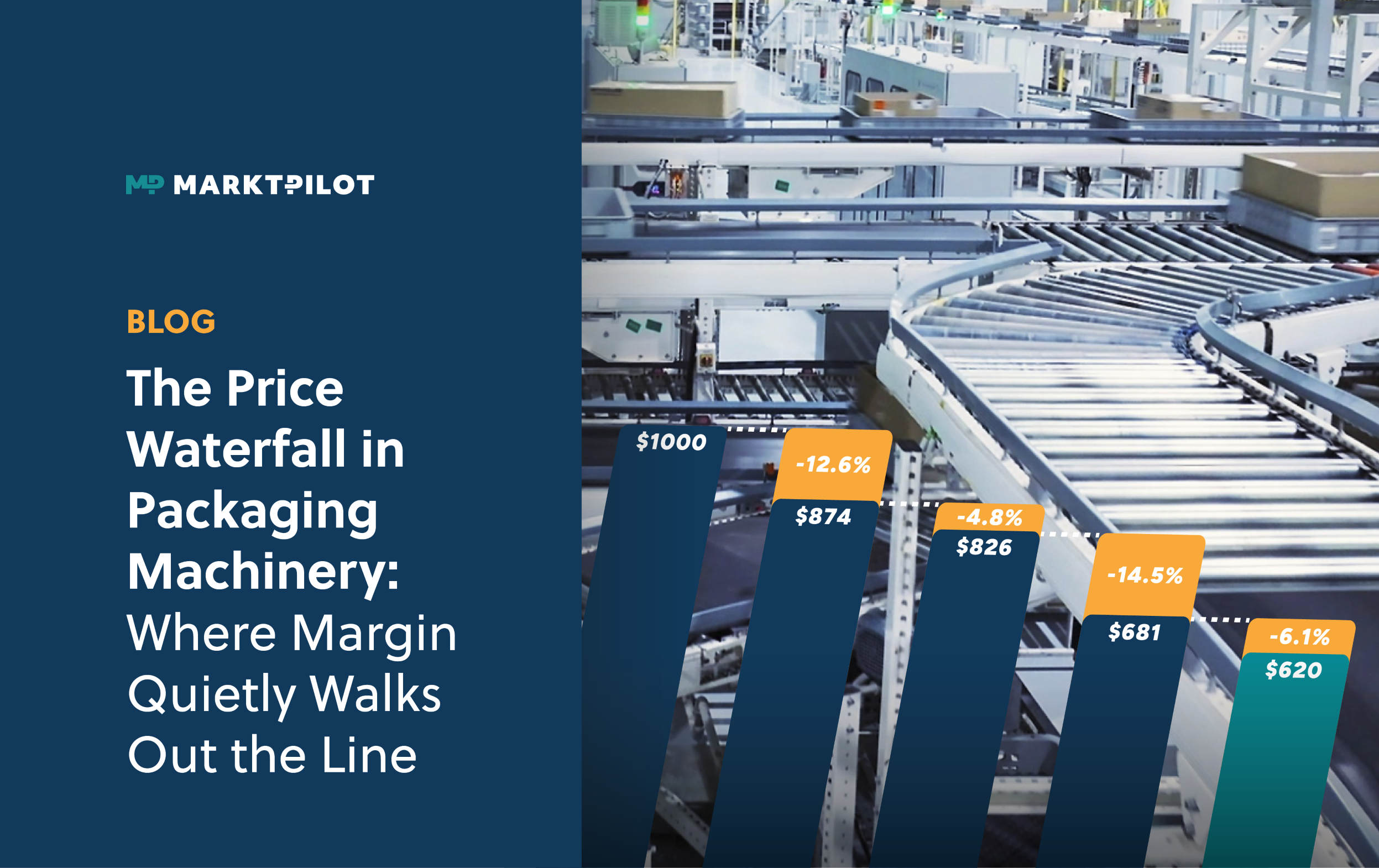
The list price below is an example value. The structure is what happens in real portfolios every day.
Almost a third of the value disappears between list and pocket. Around ten percentage points of that is recoverable: the end-market adjustment applied without modelling price tolerance differences between food and pharma, the flat rebate on a frequently-replaced wear part, the off-invoice items tracked only at portfolio level.
One percent on this single SKU is roughly USD 9 per unit. Across a packaging portfolio sold across food, beverage, pharma, chemical, and personal care end-users at volume, the recoverable margin in a 4.5% growth market is the margin that funds the next decade of R&D.
What a Working Waterfall Actually Needs?
Whatever you build or buy, three capabilities have to work together. Any one of them in isolation will not move pocket margin.
- Market intelligence at the SKU level, refreshing in days rather than years, with end-market context and aftermarket substitutes included. So pricing for a pharma customer reflects pharma reality, not generic distributor logic.
- Pricing logic that knows the difference between a food customer and a pharma customer, and applies different defense to each. With governance for distributor, direct, and aftermarket channels, all governed from one place.
- Net price realisation visible end-to-end, with simulation before you push a change. So a tariff pass-through is tested by end-market in a sandbox before it lands on the customer invoice.
It is what companies like OPTIMA, operating a complex global spare parts portfolio across multiple platform types, have come to understand: the portfolio is too large, too fragmented across regions and end-markets, for an annual review cycle to cover accurately. The question is no longer whether to automate pricing intelligence across the full catalogue. It is whether you build the capability before or after your margin tells you that you should have.
“You are either underpricing the pharma customer or overpricing the personal care customer. Both are leaks.”
What Changes the Day You See It All?
MP ONE™ is one answer to this. Whatever platform you put behind it, the shift in day-to-day pricing work looks the same:
- You stop discovering end-market leaks at the year-end review. You see them the day they open, on the SKUs and segments where they matter.
- You stop pushing one tariff response across the catalogue. You pick the SKUs and end-markets where pass-through actually holds and you absorb where it does not.
- You stop pricing pharma and food the same way. Each end-market defends its own margin on its own terms, with data to justify it.
- You stop wondering whether last year's update made it to pocket across distributor and direct channels. You watch it land in real time.
- You stop treating aftermarket parts as the tail. They become a managed margin and retention engine.
That is the shift. One way to deliver it, and the way MP ONE does, is by unifying three capabilities most packaging OEMs currently have scattered across systems and teams. The Intelligence Engine watches the market continuously. The Decision Engine applies pricing logic at the SKU and channel level. The Performance Engine tracks what actually realises in pocket. One platform, one waterfall, one source of truth.
You can check your price waterfall calculator below.
Stop Watching Margin Walk Out the Door
In a 4.5% market, you do not have another full pricing cycle to figure this out. Tariff policy is not stabilising. Your end-market customers are not becoming less aware of what they are paying. And the aftermarket parts business that is now your primary retention tool is still being priced as if it were secondary.
Every quarter your competitor runs on a continuous waterfall with end-market and channel logic, and you run on an annual one with a uniform discount tree, they take margin you did not know you had.
The packaging OEMs that come out of this decade ahead will have done one thing in common: they will have stopped treating spare parts pricing as the thing that happens after the deal is closed. Companies like OPTIMA are already building toward this. The rest will eventually get there too. The only question is whether the waterfall teaches you that lesson in a planned way or at the Q3 review.