The Price Waterfall in HVAC: Where Refrigerant Transition Margin Quietly Disappears
The HVAC refrigerant transition and the D2C channel shift have broken the annual pricing cycle. Here is the price waterfall, the four pressures driving it, and what MP ONE actually changes.
Content:
- What the Price Waterfall Reveals for HVAC OEMs?
- Where the Margin Is Going?
- How the Waterfall Behaves on One Part?
- What a Working Waterfall Actually Needs?
- What Changes the Day You See It All?
- Stop Watching Margin Walk Out the Door
On May 21, 2026, the U.S. EPA issued a final rule lifting the January 1, 2026 prohibition on installing new R-410A residential and light commercial equipment. Industry groups estimate the rule change could add roughly USD 13 billion in costs to the HVACR sector, because it expands demand for refrigerants whose supply is still phasing down under the AIM Act statutory schedule.
You are now pricing into two refrigerant generations at once. R-454B and R-32 catalogues have no historical market pricing benchmark, because the generation did not exist three years ago. R-410A inventory whose value seemed settled in March just shifted on a Wednesday morning.
R-410A prices are already up 40 to 70 percent from 2022 levels. The 2029 phasedown step, which cuts allowances from 60% to 30% of baseline, is the steepest single reduction in the schedule and still ahead.
And if you have stood up a D2C channel alongside your dealer network in the last three years, you now have two pricing systems that do not talk to each other. Your dealer can see your own SKUs priced differently on your own website within an hour of any update.
Your annual pricing cycle gives you no answer to any of this.
The answer lives inside the price waterfall.
What the Price Waterfall Reveals for HVAC OEMs?
The price waterfall is the path a part takes from list to pocket. List, distributor or dealer discount, channel-specific adjustment, customer rebate, off-invoice items, freight, returns, warranty allowance. Each step is small. Each is invisible to the next one upstream. Most HVAC OEMs see two numbers, the top (list) and the bottom (gross margin at year-end). Everything between is dark.
Right now, that dark stretch is under unusual stress:
- A refrigerant transition that keeps moving. The 2024 HFC phasedown step dropped baseline allowances to 60%. The May 2026 reconsideration rule extended the dual-catalog window. The 2029 phasedown to 30% is the steepest step in the statutory schedule. You are pricing R-410A, R-454B, and R-32 systems in parallel, with the legacy generation's value shifting on regulatory news.
- Input cost inflation that has not paused. Section 232 duties on semi-finished copper at 50% since August 2025. BOM costs up 5 to 15% annually. Equipment lead times stretched to 6 to 20 weeks for compressors, EC motors, and microchannel coils.
- A repair-and-replacement market that has structurally flipped. Replacement and retrofit now account for the majority of HVAC equipment activity. The aftermarket is no longer the secondary business. It is the primary one.
- A D2C channel layered over a dealer network. HVAC companies are building ecommerce platforms to control margin and customer relationships. Without channel-specific pricing governance, those two channels eventually compete with each other on the same SKUs.
Four pressures, one waterfall. The HVAC OEMs that hold margin through the rest of the transition are the ones that can actually see it.
Where the Margin Is Going?
You probably recognise at least three of these:
- Cost-plus pricing into a refrigerant vacuum. The R-454B compressor catalogue has no historical pricing benchmark, because the generation did not exist three years ago. Most OEMs are pricing it on cost-plus instinct while aftermarket suppliers watch what sticks and respond faster.
- An annual pricing window that does not align with a regulatory calendar. The 2026 reconsideration rule landed in May. The 2027 leak detection retrofit deadline comes January 1. The 2029 phasedown cuts baseline by another 30 points. Your pricing review cycle was designed for a market where the regulatory picture changed once a decade, not once a year.
- A D2C site that competes with your own dealer. Build an ecommerce channel without channel-specific governance and your best dealer eventually finds an SKU listed cheaper on your own website. The dealer's response is not anger. It is quiet defection.
- One discount logic for everything. Heat pumps, scroll compressors, ductless mini-splits, R-410A legacy parts, R-454B new generation. Same discount tree. Different competitive realities. Different end-customer willingness to pay.
- A waterfall nobody owns. Corporate sets list. Sales negotiates discount. Finance reconciles off-invoice. Pricing data lives across ERP, dealer management systems, and the ecommerce platform. Nobody watches the whole path at the SKU level, so nobody knows where the leak is. Only that it happened.
This is the trap most HVAC pricing teams underestimate. The D2C channel is not just a new sales motion. It is a public pricing record. Once you have stood up your own ecommerce site, every price you set is visible to your dealer network within an hour. If the governance layer is missing, your direct-to-consumer site will post a price that your best dealer cannot match. The dealer's response is not anger, it is quiet defection: the next time a homeowner asks for an installer recommendation, your equipment is not the recommendation. This is not a CRM problem. It is a pricing problem. And the legacy HVAC pricing process has no answer for it.
Want to see what this looks like on your own portfolio?
How the Waterfall Behaves on One Part?
A single SKU. A new-generation scroll compressor for R-454B residential and light commercial systems. It ships across heat pumps, packaged units, and split systems. There is no historical pricing benchmark on this generation, because the refrigerant transition is too recent. The same pattern shows up on EC motor assemblies, microchannel coils, and any new-generation part where the market is still finding its price.
The list price below is an example value. The structure is what happens in real portfolios every day.
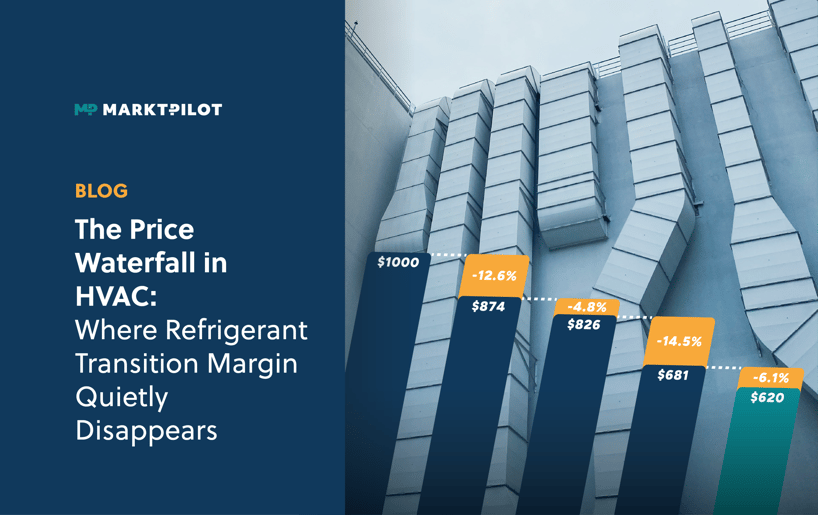
More than a third of the value disappears between list and pocket. Around eleven to thirteen percentage points of that is recoverable: the channel-conflict adjustment that should have been built into governance before the conflict appeared, the flat rebate on a part with limited substitution risk, the warranty allowance set wider than the new-generation failure data yet justifies.
One percent on this single SKU is roughly USD 18 per unit. Across an HVAC portfolio of tens of thousands of active SKUs across multiple refrigerant generations and channel types, the recoverable margin compounds quickly in a market that is not growing fast enough to absorb it otherwise.
What a Working Waterfall Actually Needs?
Whatever you build or buy, three capabilities have to work together. Any one of them in isolation will not move pocket margin.
- Market intelligence at the SKU level, refreshing in days rather than years, including cross-references on the new refrigerant generation as benchmarks emerge. So you know what the market is paying as it forms, not after the fact.
- Pricing logic with explicit channel governance, so dealer and D2C prices follow rules that prevent self-cannibalisation. Different terms by channel, defended by data, not by reactive correction.
- Net price realisation visible end-to-end, with simulation before you push a change. So a regulatory or tariff adjustment is tested in a sandbox before it touches the dealer file or the ecommerce listing.
Without those three, HVAC pricing is one regulatory event away from carrying losses the new equipment cycle cannot offset.
“The R-454B compressor catalogue has no historical pricing benchmark because the generation did not exist three years ago.”
What Changes the Day You See It All?
MP ONE™ is one answer to this. Whatever platform you put behind it, the shift in day-to-day pricing work looks the same:
- You stop discovering the refrigerant transition leak at the year-end review. You see it the day a regulatory or competitive move reshapes pricing, on the SKUs where it matters.
- You stop guessing on R-454B pricing. You build the benchmark as the market builds it, on the parts where the new generation is actually selling.
- You stop having your D2C site undercut your best dealer. Channel governance is in the pricing logic, not in a quarterly damage-control meeting.
- You stop wondering whether last year's update made it to pocket across distributor, dealer, and ecommerce channels. You watch it land in real time.
- You stop treating R-410A and R-454B inventory the same way. Each generation defends its own margin on its own terms.
That is the shift. One way to deliver it, and the way MP ONE does, is by unifying three capabilities most HVAC OEMs currently have scattered across systems and teams. The Intelligence Engine watches the market continuously. The Decision Engine applies pricing logic at the SKU and channel level. The Performance Engine tracks what actually realises in pocket. One platform, one waterfall, one source of truth.
You can check your price waterfall calculator below.
Stop Watching Margin Walk Out the Door
You do not have another full pricing cycle to figure this out. The AIM Act phasedown is not pausing. The next regulatory reconsideration is not pausing. The dealer who is comparing your D2C site to your wholesale list price is not getting more patient.
Every quarter your competitor runs on a continuous waterfall with channel-specific governance and you run on an annual one with a uniform discount tree, they take margin you did not know you had.
The HVAC OEMs that hold margin through the refrigerant transition and the D2C shift will have done one thing in common: they will have killed the idea that channel pricing manages itself. Their D2C site will not have found an OEM price lower than the dealer's net, not because someone caught the conflict, but because the governance logic was built before the problem appeared. The OEMs that do not will spend years explaining at the board why their own channel strategy cost them their strongest dealer relationships.
Download: The Price Waterfall - Hidden Map to Spare Part Profit
We are MARKT-PILOT
We make pricing effortless, so manufacturers can grow with confidence.
Our platform, MP ONE™, redefines how manufacturers compete in a world where markets never stand still. By unifying intelligence, decisions, and performance into one platform, we deliver clarity into what's happening, confidence to act, and control over results. That's Pricing Performance.
200+ manufacturers trust us. Join us and grow your future.
Learn more about MARKT-PILOT