Content:
What Is Pricing Performance in Spare Parts Pricing?
Pricing Performance is the discipline of keeping every price right, continuously, as the market moves. A price is only right when it is current, controlled, and proven at the same time: current with what the market is doing now, controlled through governed strategy that finance can approve and sales can defend, and proven against measured results. Miss any one and the price drifts wrong. In spare parts pricing, where manufacturers manage portfolios of 50,000 to one million SKUs, this replaces the annual spreadsheet exercise with a continuous, governed operating model.
Start with a Harder Question
"Is every price in your spare parts portfolio right, right now? And if your CFO or your biggest distributor asked you to prove it, could you?"
Almost no one can answer yes. That is not a failure of the pricing team. Every price in the book was right the day someone set it. The problem is what happens to a price after it is set, in a market that does not stop moving. Nobody decides to be wrong. The market simply keeps moving after the decision stops.
The Villian is Drift
The distance between a price you set and a market that kept moving is price drift. It is silent, it compounds, and it is widening right now on parts you are not looking at. Its formal name is the Static Pricing Gap: the distance between what your prices say and what the market is actually doing. For manufacturers running large spare parts portfolios, that gap is not a minor inefficiency. It is a quiet, compounding drain on margin, revenue, and competitive position.
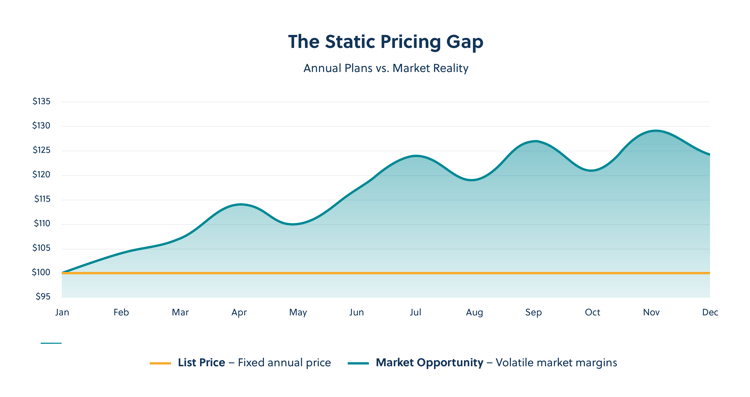
Drift exists because the market changed structurally while most pricing operating models did not. Tariffs shift without warning, conflicts disrupt supply routes, input costs fluctuate, and competitors adjust prices faster than ever. This is the Dynamic Machine Economy: a market that is constantly changing, deeply interconnected, and increasingly transparent to buyers who research before they buy and notice when they are being overcharged. Annual price reviews and cost-plus formulas were built for a world that moved slowly. That world is gone.
The scale of the drift is measurable. MARKT-PILOT's analysis of more than 800,000 spare part data points shows that just 4.1 percent of parts in a typical portfolio are priced in line with the market. The other 96 percent have drifted, either underpriced, leaving margin unrealized, or overpriced, reducing win rates and eroding trust.¹ More than a third of manufacturers (34.7 percent) adjust prices only "as needed," with no systematic cadence, while every part competes with 11.8 alternative sellers on average.¹
Drift Shows up Everyday as Pain
You have almost certainly already met drift. It just wears a disguise. The expert who owned pricing leaves, and the logic leaves with them. The aftermarket is less profitable than it should be and no one can say exactly why. Share erodes on parts you used to own, and you hear about it from distributors months late. Prices you can't fully stand behind, because you can't defend the increase when the pushback comes. A growth target parts has to carry, with no clear map of where it comes from.
These feel like separate problems. They are not. They are one problem surfacing in different parts of the P&L. That is why the fix was never a better spreadsheet, one more data subscription, or a point tool bolted on the side. You cannot cure a single condition by treating one symptom at a time. The fix is a different standard for what a price has to be.
What Makes a Price Right: Current, Controlled, Proven
Pricing Performance is not a single pricing model, and it is not a tool. It is the operating discipline of holding three conditions on every price at once, as the market keeps moving.
-
Current: the price reflects everything moving beneath it right now, not what was true at the last annual review. That means three kinds of signal at once. External: what competitors charge and how many alternatives exist for each part. Internal: your own costs, margins, and sales patterns, the ground truth on what a price is actually doing. And macroeconomic: the tariffs, commodity swings, fuel, and supply shifts that reset the floor under a whole segment overnight. A price that tracks competitors but misses a cost increase is just as drifted as one that never looked at the market at all.
-
Controlled: the price is set deliberately, through governed strategy your finance team can approve and your sales team can defend, not ad hoc and not held in one person's head. Control means two things at once. Governance: every price carries guardrails, an approval trail, and a documented rationale, so anyone can see who set it, why, and on what evidence. And institutionalization: the pricing strategy and the process that produces it live in the system itself, not in an analyst's memory or a spreadsheet only one person understands. The logic becomes company property. When the person who owned pricing leaves, the discipline stays, and the next hire inherits a working system instead of starting over.
-
Proven: the price is backed by evidence, measured against what you intended, and continuously watched so you learn what worked and act on what changed. This is the half that never stops. Every decision is measured against its intent, did the reprice hold, did margin actually recover, did the win rate move. Outcomes feed back into the next decision, so the system gets sharper each cycle instead of starting cold. And the watching is active, not periodic: when a competitor moves, a cost shifts, or a captive part starts drawing alternatives, the system flags it and the loop restarts before the next annual review would ever have caught it. Proven is what turns pricing from an event into a discipline that compounds.
Miss any one and the price drifts wrong. A current but ungoverned price is inconsistent. A controlled but stale price is precise about the wrong number. And neither can be trusted without proof. The difficulty is that these three conditions are usually pursued in isolation, with different data, tools, and owners, which is why prices drift wrong even when each piece is handled well.
How the Discipline of Pricing Performance Works
Delivering all three conditions runs on a continuous loop: sense what the market is doing, decide how to respond, execute the decision into the price book, and measure the outcome. That loop feeds itself. Every result sharpens the next decision.
The shift it requires looks like this:
-
From static to continuous: prices are monitored and adjusted in response to real market signals, not reset once a year and left to drift for twelve months.
-
From assumptions to market evidence: decisions are grounded in current competitor prices, availability signals, and demand patterns, not in historical instinct or last year's cost structure.
-
From list price to net price: the focus moves from nominal list prices to what is actually realized across regions, channels, and customer segments. That is where margin leakage actually lives.
-
From project to system: pricing becomes a governed, scalable operating capability with clear accountability and full traceability, not an occasional cleanup exercise that starts from scratch each cycle.
One thing this is not: repricing everything, all the time. Pricing decisions are rarely binary, and a large portfolio needs different logic depending on context. Cost-plus logic still fits where market visibility is limited. Market-based logic becomes essential where competition is transparent and substitutes are easy to find. Value-based logic is critical where uptime and differentiation shape willingness to pay. Context is the clearest across the life of a part: a newly launched proprietary part enters the market captive, with room for an early-life premium; as the installed base grows and third-party sources multiply, a rising alternative count is the signal to revisit price; late in life, alternatives thin out and a controlled increase becomes possible again. One methodology cannot serve all three stages, but context-aware decisioning can.
What Pricing Performance Looks Like in Practice
Picture a manufacturer with 80,000 spare parts SKUs across Germany and the US. Under the old model, the annual review takes six weeks and produces a single global list price. Regional distributors discount informally. Finance has no clear view of net price realization. When a key competitor raises prices on a high-volume bearing line in March, the manufacturer finds out in the next annual cycle: eleven months of margin left uncaptured. That is drift, in one line item.
Under a Pricing Performance model, that competitor move is detected within days. The pricing manager sees the affected SKUs, the recommended adjustment, and the rationale. A regional strategy for Germany can be configured and governed separately from the US. Every distributor discount is tracked against a baseline. And after the cycle closes, the team can see precisely which decisions moved the needle and feed that learning into the next decision.
The payoff is well documented. Spare parts typically account for around 10 percent of a machine manufacturer's revenue but close to 25 percent of profit, and McKinsey finds that OEMs prioritizing the aftermarket run margins up to four times higher than those focused on new-equipment sales alone.² Pricing is the lever with the most leverage of all: a 1 percent improvement in realized price translates into roughly an 8 percent increase in operating profit, more than any cost or volume initiative delivers.² More than 200 manufacturers rely on MARKT-PILOT for Pricing Performance, together realizing over 200 million USD in additional revenue.³ The system compounds. That is the point.
The Pricing Performance Self-Assessment: See Where Your Pricing Stands Today
Why the Operating Model Matters as Much as the Technology
A common misconception in spare parts pricing is that this is purely a technology problem: buy a better pricing tool and it's solved. The tool matters, but a tool without the operating discipline produces the same result as the spreadsheet: decisions made in isolation, outcomes unmeasured, learnings lost.
Pricing Performance is a team sport. Finance gains visibility into how pricing decisions drive growth and profitability. Leadership can treat pricing as a strategic lever rather than administrative overhead. Pricing teams get a continuous, closed-loop operating model instead of disconnected quarterly exercises. Sales works from market-aligned prices rather than annual guesses. When the whole organization understands pricing as a growth capability, the returns compound faster, and the gap between manufacturers who have built this capability and those who have not widens, quietly, every quarter.
Pricing Performance Is Not the Future. It's What Leaders Are Doing Now.
The manufacturers pulling away in the aftermarket are not waiting for the next annual review. They are running pricing as a continuous performance discipline, capturing margin their competitors leave on the table, and building institutional advantage that gets harder to close every quarter.
For after-sales and pricing leaders at machine manufacturers, the question is not whether to build Pricing Performance as a capability. It's whether you build it before the manufacturers you compete with do.
Sources
¹ MARKT-PILOT Global Parts & Service Report 2025
² McKinsey & Company, pricing research across the S&P 1500
³ markt-pilot.com