Blog
10 Ways to Determine the Value of a Parts Pricing Software
When it comes to running a sustainable spare parts business, determining the value of a parts pricing software is a crucial step.
Key insights from Spare Parts Business Platform 2026: data-driven pricing, installed base intelligence, lifecycle services, and the future of spare parts.
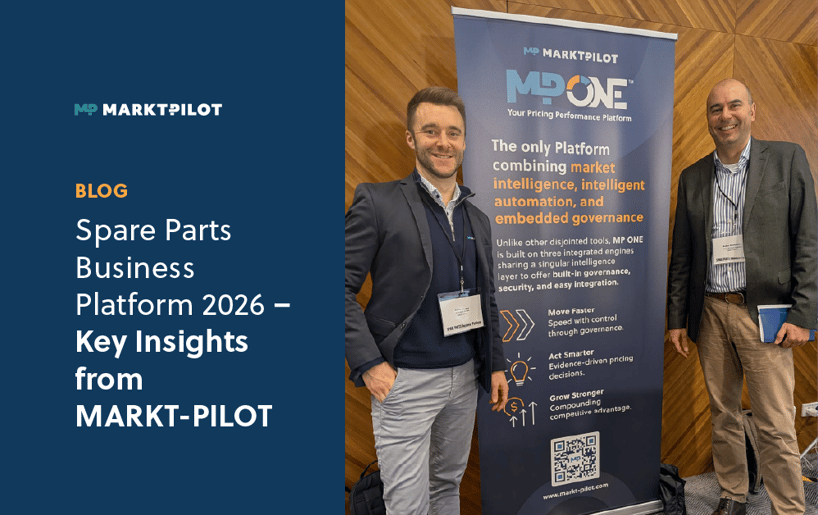
The Spare Parts Business Platform 2026 – The Power of 50, hosted by Copperberg, brought together industry leaders to discuss the future of the spare parts business. Across keynotes and roundtables, one message stood out: the spare parts business is becoming more transparent, more data-driven and more strategically managed than ever before.
Table of Contents:
For us at MARKT-PILOT, the event was especially valuable as we had the opportunity to actively contribute to the discussions. Our colleagues Stefan Sandulescu, Senior Solutions Engineer, and Steven Kugler, VP Sales Europe, hosted roundtable sessions where participants shared practical experiences and challenges around the spare parts business.
The conversations reinforced several trends we are currently observing across the industry. Topics such as spare parts pricing transparency, availability, competitive benchmarking, portfolio complexity, and data-driven decision-making dominated the discussions and highlighted how quickly the aftermarket landscape is evolving.
A recurring theme across the event was the transition away from reactive spare parts sales.
In his keynote, Ioannis Chatzilamprou (Metso) illustrated how simplifying spare parts portfolios and focusing on lifecycle solutions can dramatically improve performance. By reducing complexity and integrating spare parts with modernization and installed base insights, Metso achieved higher order volumes and improved profitability.
Similarly, Marco Mambretti (Cavotec) highlighted how companies are moving from passive RFQ-driven spare parts sales toward proactive service models supported by forecasting, installed base intelligence, and service kits.
This shift reflects a broader industry trend: spare parts are no longer simply replacement components, they are part of a holistic lifecycle value proposition.
"Copperberg Spare Parts Business was as expected: filled with valuable content and exciting insights into the world of Spare Parts in the Manufacturing space. All participants were energized and knowledgeable in their respective fields of expertise and businesses - sharing new aspects of their day-to-day challenges."

Another major theme in the roundtables was the growing pressure on spare parts pricing.
Digital procurement platforms, online marketplaces, and global sourcing are rapidly increasing transparency in what was historically a relatively opaque aftermarket.
Philipp Schmitz (Fastems) described in his keynote how the traditional OEM advantage of limited transparency is gradually disappearing. Customers today can compare suppliers more easily than ever before, and pricing decisions are increasingly influenced by digital procurement tools.
As a result, manufacturers can no longer rely on historical markups or static price lists. Instead, companies need reliable market intelligence and systematic benchmarking to understand where their spare parts prices stand in the market.
This observation strongly aligns with our findings from the MARKT-PILOT Global Parts & Service Report which highlights increasing price competition and the rise of alternative suppliers as major challenges for OEM spare parts businesses.
For many companies, spare parts pricing is therefore evolving from a static administrative process into a strategic discipline that directly impacts profitability and competitiveness.
“OEMs aim to price their spare parts fairly yet profitably — to secure volume, support new machine sales rather than hinder them, stay aligned with market levels, and reflect the true value and availability of each part. At the same time, prices need to fit accurately across part groups, regions, and customer segments. How would you approach building such a pricing logic in Excel?”

Spare parts systems are inherently complex: thousands of SKUs, long lifecycles, intermittent demand patterns, and global supply chains.
Dmitry Shurmin (Orchestrated Intelligence) explained how organizations are beginning to manage this complexity using digital twins, system simulations, and AI-based decision intelligence.
These approaches allow companies to simulate decisions, detect root causes, and better understand cross-dependencies across their spare parts ecosystem.
To manage large spare parts portfolios effectively, companies need better analytical tools to continuously optimize decisions across thousands of parts.
However, the roundtables made it clear that technology alone is not enough. Organizational alignment, data quality, and governance remain critical success factors.
Across many sessions, one insight stood out: customer expectations are evolving rapidly.
Customers increasingly expect spare parts procurement to resemble modern e-commerce, fast availability checks, transparent pricing, and reliable delivery.
In this new environment, speed and service quality often outweigh price alone.
.jpg?width=2000&height=1500&name=shared%20image%20(4).jpg)
For us at MARKT-PILOT, the event reinforced that the aftermarket is entering a new phase.
The companies that will succeed in this environment are those that combine:
In short, the spare parts business is evolving from an operational necessity into a strategic growth engine for machine manufacturers.
At MARKT-PILOT, we help manufacturers tackle this challenge.
With MP ONE, our unified Pricing Performance Platform, pricing teams gain continuous market visibility and can benchmark their prices against real market data. The result: clearer decisions, better margin control, and a structured approach to managing large spare parts portfolios.
Learn more about MP ONE and how manufacturers turn pricing into a continuous performance lever.
A big thank you to Copperberg for organizing such a valuable event and bringing together a strong community of experts and practitioners.
We look forward to continuing these conversations and helping shape the next chapter of the spare parts business.
Join us on June 2, 2026, in Chicago for PARTS FORUM 2026. Join the industry’s leading minds for a day of insights, networking, and inspiration that will shape the next era of aftermarket excellence.

When it comes to running a sustainable spare parts business, determining the value of a parts pricing software is a crucial step.
ISO 27001 Certified: MARKT-PILOT, your trusted partner for secure spare parts pricing. Rely on our certified data security to protect your business.
MARKT-PILOT sets a new security standard with ISO 27001 certification and advanced data protection for spare parts pricing.