GLOSSARY

Value Based Pricing

WHAT IS VALUE BASED PRICING

Definition Value Based Pricing

Value Based Pricing Definition

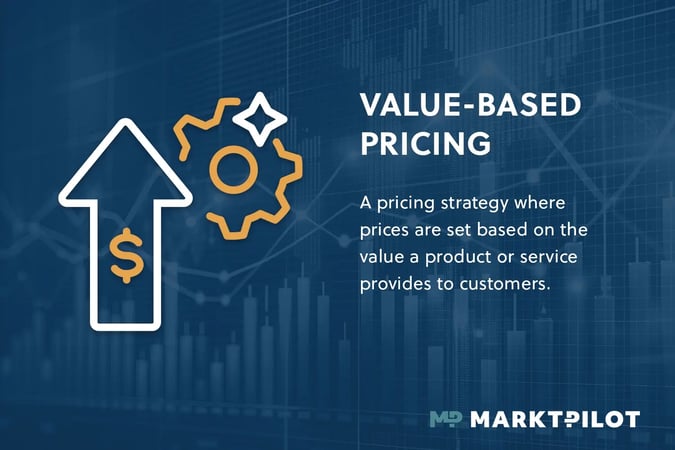
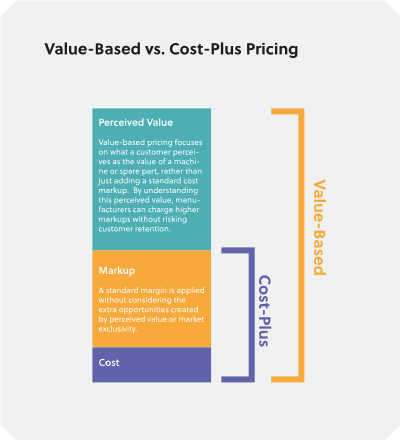
Value based pricing or value pricing is a strategy where prices are set based on the value a product or service provides to customers. This approach requires understanding what customers want, need, and are willing to pay for. Unlike cost-plus pricing, which focuses on covering production costs, or competitor-based pricing, which follows market trends, value-based pricing focuses on the benefits and value customers receive. This approach ensures prices align with what matters most to the customer.

In B2C markets, value-based pricing often reflects brand perception, especially for premium brands. However, in B2B industries like machine manufacturing, it is tied to factors such as operational efficiency, cost savings, production uptime, and regulatory compliance, elements that directly impact a customer’s bottom line. 

Most pricing teams know how they should price. The method is written down, with different rules for captive parts, competitive parts and the long tail. In practice the portfolio still runs on one multiplier, because nothing in place can execute the strategy.

One rule for every part is drift by default. A part only you sell is priced like a part six suppliers sell, one ends up too cheap and the other too expensive, and the two errors offset in the reported margin so neither shows. MP ONE™ turns the written strategy into governed rules by segment, with market data to show which segments to split first. Performance is tracked segment by segment, so the first split builds the case for the next.

Running pricing this way is what we call Pricing Performance.

What Are the Benefits of Value Based Pricing? 

Value-based pricing works best when combined with market-based pricing. Using both strategies together helps companies set prices that align with market competition while reflecting what customers are willing to pay based on perceived value, ultimately driving more revenue. 

Benefits: 

  • Higher margins compared to traditional cost-plus pricing, as customers are often receptive to paying premium prices for products that meet their distinct needs 
  • Improved market differentiation by emphasizing their unique value, such as superior quality, advanced technology, or customer-specific features 
  • Innovation driver as companies need to rethink their approach to product creation and development to produce unique solutions that customers value 
  • Strengthens customer relationships by aligning price not only with the market-value but also with the tangible and intangible benefits that customers receive 
  • Improves pricing precision in combination with market-based customer insights and data analytics to set prices that accurately reflect product value 
Infographic Value Based Pricing vs Cost-Plus Pricing
WHY VALUE-BASED PRICING

When to Use Value Based Pricing?

To use value-based pricing, companies need a clear understanding of their target market and the value their product provides.

Value pricing works best in combination with a market-based pricing strategy.

It is often used by companies offering premium or highly unique products that address important operational challenges for their customers or have no competition in the market to benchmark pricing against. For example, companies selling advanced medical equipment like MRI machines or robotic surgical systems often use value-based pricing. Instead of focusing only on production costs, they consider factors like patient outcomes, improved hospital efficiency, and long-term cost savings. This approach helps justify higher prices by highlighting the clinical and operational benefits for healthcare providers. 

VALUE-BASED PRICING IN MACHINE MANUFACTURING

For manufacturers, value-based pricing helps capture the true worth of highly specialized machines and components and gives direction in areas with little to no competition on the market. This is particularly important in: 

  • Spare parts pricing, where no direct competitor exists. 
  • High-end machinery, where the total cost of ownership and ROI justify premium pricing. 
  • Industry-specific, compliance-driven machines, where reliability, certifications, and service agreements add value beyond standard pricing models.

More about Pricing Strategies in Machine Manufacturing

To learn more about pricing strategies and how to combine market-based and value-based pricing in machine manufacturing, contact our experts to explore solutions for your business.

How current, controlled and proven is your pricing today? Take the Pricing Performance self-assessment.

Image showing bars and graphs and a man holding a pen in front of a laptop
WIKI

How to Create an Effective Pricing Strategy for Manufacturing Companies

A well-crafted pricing strategy ensures your business can adapt to market conditions, cover costs, and secure brand loyalty.

Learn more
Mock Up of The ultimate Guide to Parts-Pricing
GUIDE

The Ultimate Guide to Market-Based Parts Pricing

Learn more about the benefits of market-based pricing, and easy steps to implement a competitive pricing strategy.

Learn more
Featured Image Blog Post about 10 Must Follow Steps for B2B Pricing
BLOG

10 Essential Steps for a Great B2B Pricing Strategy

Discover the 10 essential steps to create a successful B2B pricing strategy and to choose the right pricing model.

Learn more

About MARKT-PILOT

MARKT-PILOT™ is the industry leader in Pricing Performance for industrial manufacturers. Its unified Pricing Performance platform, MP ONE™, keeps every price current, controlled, and proven.

LEARN MORE
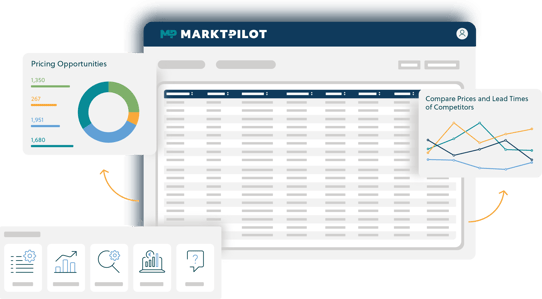
Market price and lead time data for spare parts pricing

You might be interested in our resources

Event

Built to Lead: What Aftermarket Leadership Looks Like in Practice

How Siemens Energy, Terex, CLAAS and other manufacturers price, sell and plan in the aftermarket. Insights from PARTS SUMMIT 2026 in Frankfurt.
Podcast

In the PIE-Cast Studio: Co-CEO Stephen Fauth on Creating the Pricing Performance Category

MARKT-PILOT™ Co-CEO Stephen Fauth on the PIE-Cast: why domain expertise is no longer enough, how to disrupt yourself first, what the future of...

Event

Close the Gap. Build the Community. Lead the Market.

PARTS FORUM 2026 brought aftermarket leaders to Chicago for a record-breaking day on pricing, strategy, and industry transformation. Here’s the...