Key Takeaways
Every price drifts when the market moves and your prices don’t. The cost shows up as margin left on the table or customer trust spent.
A price is right only when it is current, controlled and proven at the same time.
Pricing Performance connects the scattered pieces of pricing into one process the whole business can rely on.
MP ONE™ is the only platform that runs pricing as a continuous loop, so every price stays right between annual reviews.
The Drift
Why Every Price Drifts
Most manufacturers reprice once a year. The market moves every day, and the gap reopens the morning after each review.
Every price is right the day it is set. Then competitors adjust, costs shift and demand moves, while the price waits for the next review. We call this price drift. It opens a distance between where a price is and where the market says it should be, and that distance is the static pricing gap.
The gap costs you in two directions. A price that should have gone up leaves margin on the table. A price that should have come down spends customer trust before the next order lands. Left alone, it compounds: costs rise while prices sit still, competitors take share on parts you assumed were safe, and discounts creep.
The scale is measurable. In our analysis of more than 800,000 spare part data points, only 4 percent of parts were priced in line with the market. More than a third of manufacturers adjust prices only “as needed,” and a standardized part competes with 11.8 alternative sellers on average.¹
At MARKT-PILOT™, we believe no team can keep 60,000 prices current on experience and instinct alone.
The Definition
What Is Pricing Performance?
Pricing Performance is the discipline of keeping every price in a manufacturer’s portfolio current, controlled and proven, continuously, as the market moves. Miss any one of the three and the price drifts.
Most pricing teams already do pieces of it. One person builds a model for a product line. Another tracks steel and aluminum costs in a spreadsheet. Someone checks a competitor’s price against the list now and then. Each piece works on its own, and nothing connects what one team learns to what the next team does.
Pricing Performance joins those pieces into one process. Simple rules run automatically where risk is low, and real judgment with richer data goes where a part is complex or exposed. Internal signals such as cost and sales data meet external signals such as market prices and macroeconomic and raw material indexes, and all of them feed the same decision.
Every change is approved and traceable, and each cycle starts from what the last one taught. Pricing becomes a capability the whole business relies on to protect margin, defend share and grow, year after year.
The New Standard
Current, Controlled, Proven: What Makes a Price Right
A price is right only when all three are true at the same time. Each comes with a test you can run on any price in your portfolio today.
01
Current
Checked against live market data, your own numbers and macroeconomic movement, so it reflects today’s market.
The test
Would this price still be defensible if the market moved yesterday?
02
Controlled
Teams set it deliberately through governed strategy that finance can approve and sales can defend. It does not live in one person’s head.
The test
Does this survive the person who set it leaving?
03
Proven
Backed by evidence, the answer to “why this price” always exists. Alerts keep watching even when nobody touches it.
The test
Can we show the receipt?
Miss one of the three and the price drifts. The three conditions are not three separate jobs; they form one loop. You analyze and diagnose the price (Current), decide and approve it (Controlled), then publish and measure it (Proven).
One Loop. Zero Drift.
The Loop
How MP ONE Runs Pricing Performance
MP ONE is the only platform that runs pricing as a continuous loop. Connect your data once in the Data Foundation, and five stages run on top of it, cycle after cycle.
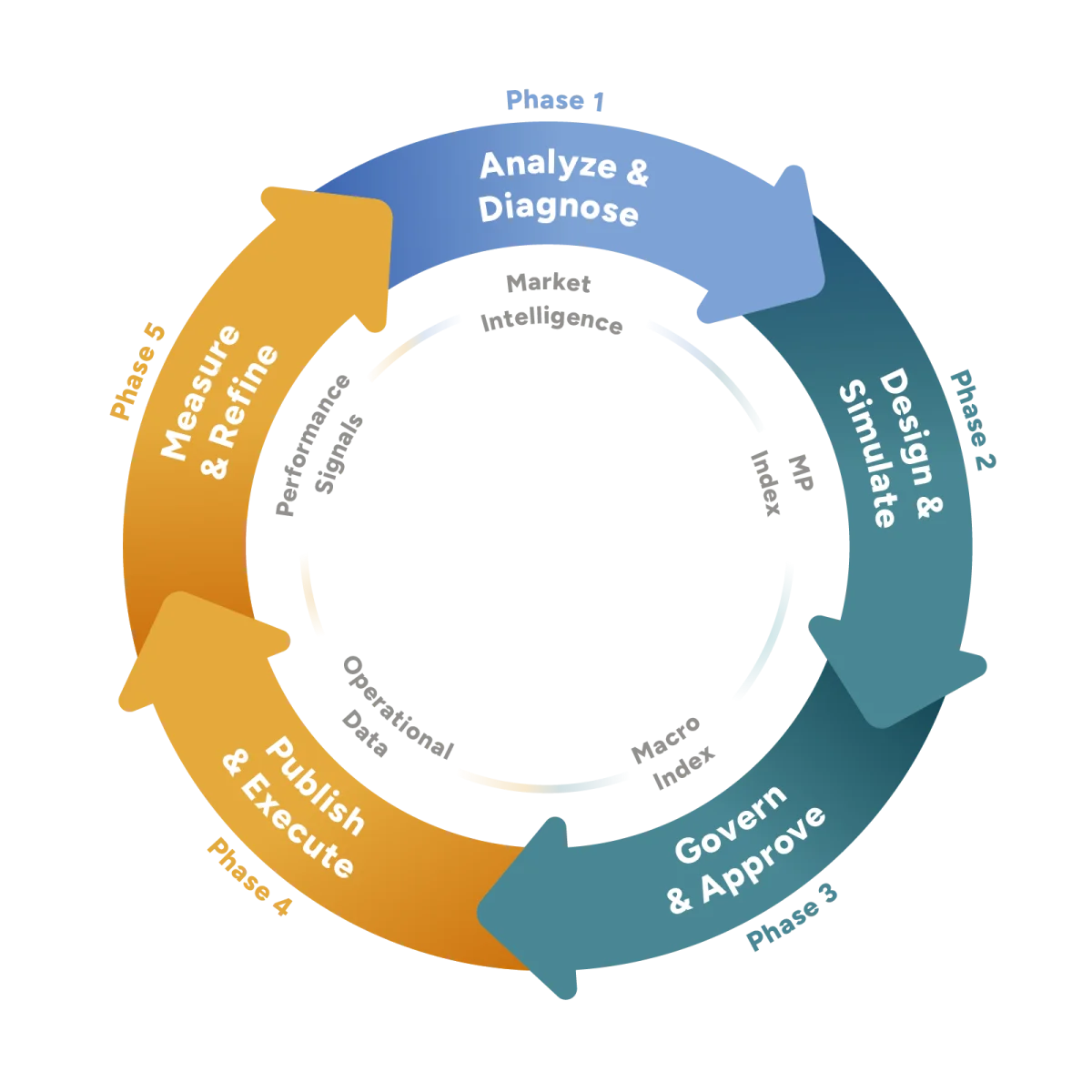
- 01
Analyze & Diagnose
See the full picture, from your own pricing to competitor moves and market changes, all in one place.
Condition: Current
- 02
Design & Simulate
Turn what you know about the market into clear pricing rules, scenarios and decisions. Teams see the logic, test the impact and scale what works.
Condition: Controlled
- 03
Govern & Approve
See who approved what, why they approved it and what the decision means for price, margin and revenue.
Condition: Controlled
- 04
Publish & Execute
Turn approved pricing into executable prices at scale, across your portfolio, channels, regions and customers.
Condition: Proven
- 05
Measure & Refine
Measure the impact of every decision, learn what worked and feed it straight back into the next cycle.
Condition: Proven
Measure & Refine feeds straight back into Analyze & Diagnose, so the loop keeps turning. Alerts keep watching prices even when nobody changes them. No price has to wait for the next annual review to become accurate again.
The Proof
What Pricing Performance Delivers
200+
machine manufacturers worldwide work with MARKT-PILOT.
² Market-based price increases across customer portfolios drive the measured ROI. We benchmarked the data across 15+ manufacturers. Actual results vary with portfolio complexity.
What Our Customers Say



Conclusion
Keep Every Price Right and Stop the Drift
Every price your team sets is right the day it goes live. Then the market moves, and the price starts to drift. Competitors who reprice continuously correct for it every quarter and pull ahead on the parts you compete over. Pricing Performance stops drift before it builds, keeping every price current, controlled and proven as the market moves. MP ONE is the only platform that runs it as one continuous loop.
The Test
Is Every Price in Your Portfolio Right, Right Now?
Take the self-assessment and see how close your pricing is to the standard of current, controlled and proven.