Somewhere right now, a pricing manager at an industrial manufacturer is updating a spreadsheet that was already wrong when they opened it. Input costs shifted last week. A competitor changed their prices three weeks ago. A regional distributor has been quietly discounting to protect volume. None of that is in the spreadsheet. And next year’s price list will be built on top of it.
The Invisible Costs of Static Pricing
For most industrial manufacturers, pricing a parts portfolio of 50,000 to one million SKUs still means annual reviews, cost-plus formulas, and a lot of gut instinct. It is a system designed for a world where markets moved slowly. That world no longer exists.
Since 2018, cost volatility in industrial value chains has increased by a factor of three to five. Price changes in many B2B markets now occur 40–60 percent more frequently than before.1) Meanwhile, B2C-level price transparency means buyers now notice when they are being overcharged, and switch accordingly. The result: manufacturers lose margin when they underprice, lose customers when they overprice, and discover which of the two happened months after the fact.
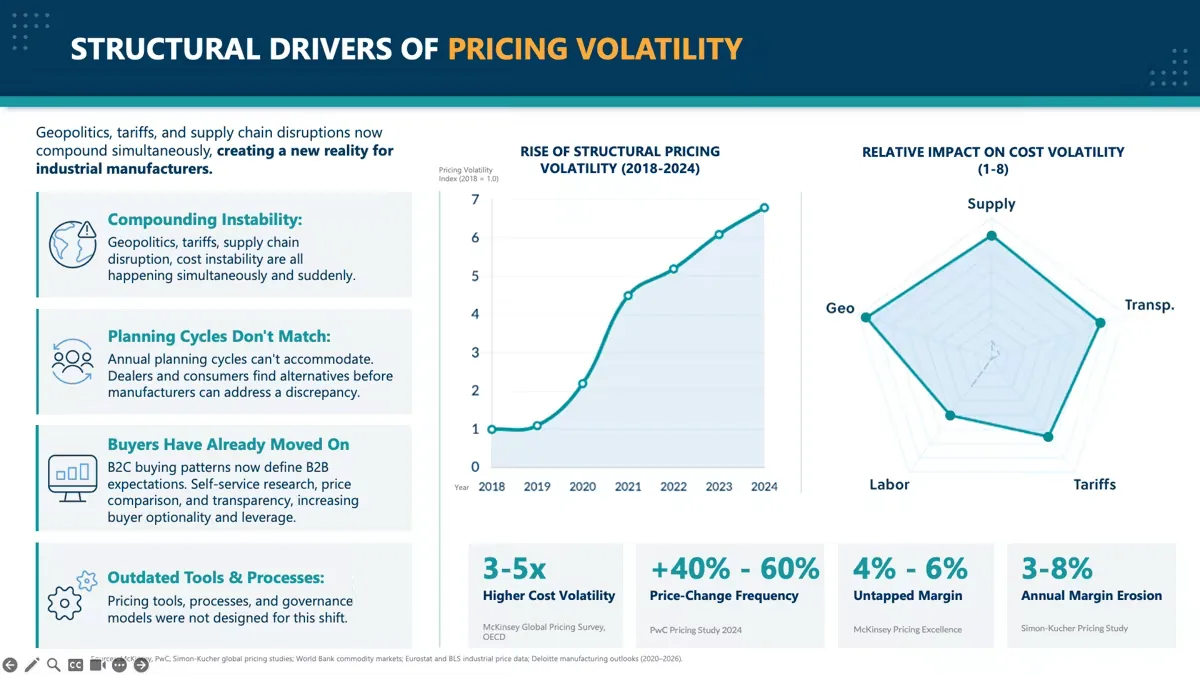
This is the Static Pricing Gap. And it is not a small inefficiency. It is a structural drag on revenue, margin, and competitive position that compounds quietly, year after year.
Pricing Performance: The Discipline That Separates Leaders
Pricing Performance is a continuous operating capability: the ability to sense what the market is doing, decide how to respond, act with speed and governance, and measure the financial outcome. All year long. At scale. The shift in operating model looks like this:
- From static to continuous: Prices are monitored and adjusted in response to real market signals, not reset once a year and left to drift.
- From assumptions to market evidence: Decisions are grounded in up-to-date competitor prices, availability, and demand, not in historical instincts.
- From list price to net price: Focus moves from nominal list prices to realized net price across regions, channels, and customer segments.
- From projects to system: Pricing becomes a governed, scalable operating capability with clear accountability and full traceability.
Introducing MP ONE: One Platform, Three Engines, Fully Connected
Most manufacturers today run pricing across a patchwork of ERP exports, spreadsheets, and disconnected pricing tools. MP ONE is MARKT-PILOT’s answer: the first unified Pricing Performance platform built specifically for industrial manufacturers.
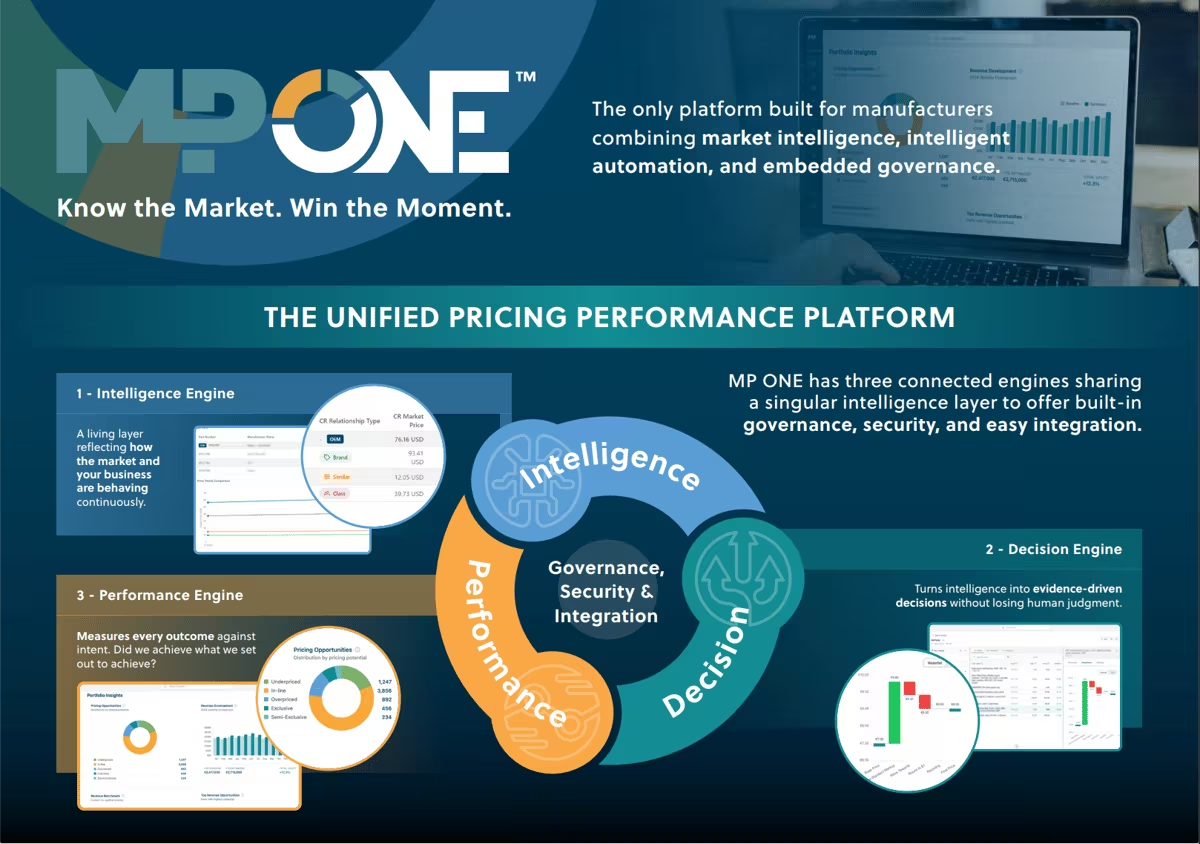
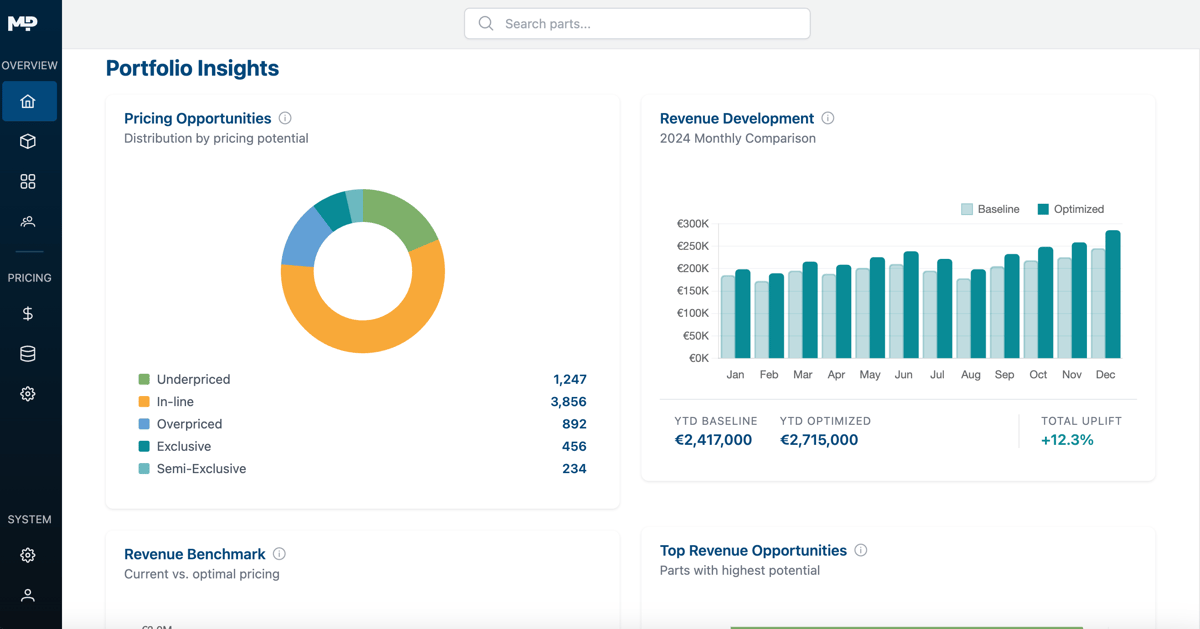
- Intelligence Engine gives you a living, SKU-level view of what the market is actually doing right now, unifying internal data (ERP, PLM, CRM, CPQ, sales history) with real-time external signals (competitor prices, availability, lead times, cross-references).
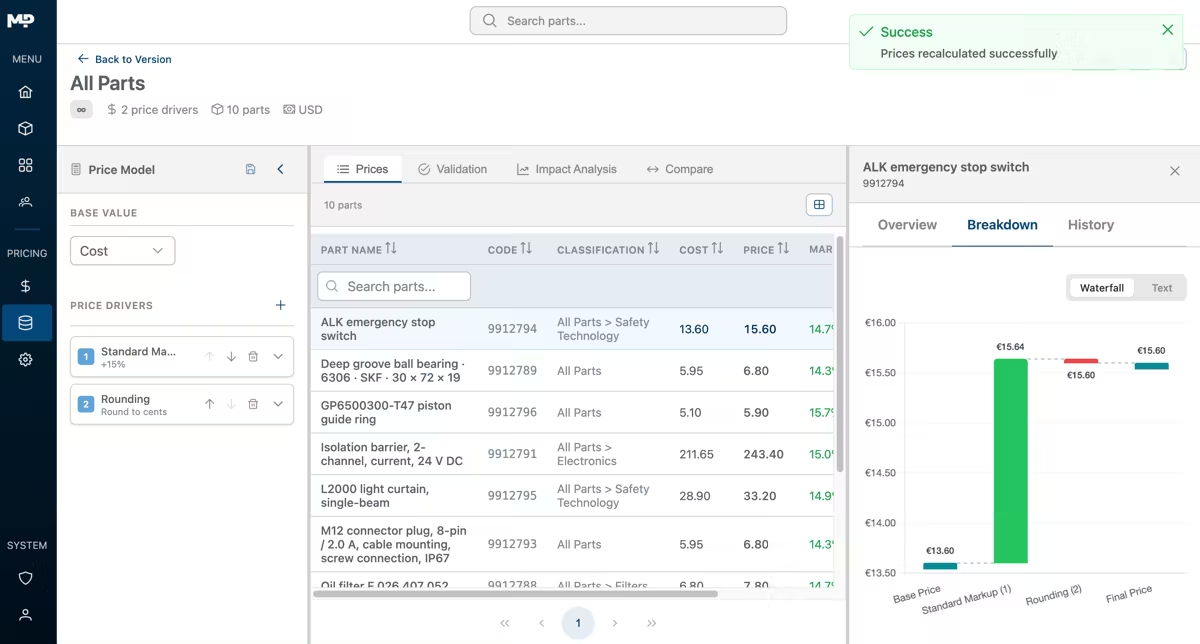
- Decision Engine turns intelligence into governed pricing action. Teams configure pricing models (cost-plus, market-based, value-based, or custom), manage price books, and execute with clear workflows, approvals, and full auditability.
- Performance Engine closes the loop. Every pricing decision is measured against real revenue, margin, and portfolio outcomes, and those learnings feed directly back into Intelligence and Decision.
The Compounding Advantage: Why Every Quarter Matters
For every €100 million in revenue under management, MP ONE typically unlocks €4–5 million in additional annual revenue and delivers a 13–18x ROI within the first year.2) These are benchmarked outcomes driven by market-based price increases, eliminated discount leakage, and better portfolio management, all governed and traceable.
This is not a one-time investment with a static return. Every quarter on Pricing Performance, the advantage compounds. The data gets richer. The pricing models get sharper. A competitor who starts today and one who starts six months from now will be separated by six months of compounding. That gap does not shrink. It widens.
Why Static Pricing Organizations Fall Behind
Static pricing organizations will still win deals. But quarter by quarter, they are ceding ground on margin, on customer retention, and on institutional knowledge. This is not a loud disruption. It is a quiet, compounding separation, and by the time it is visible, it is already very hard to close. Pricing Performance is not the future of industrial pricing. It is what the leaders are already doing.
1) Sources: McKinsey, PwC, Simon-Kucher global pricing studies; World Bank commodity markets; Eurostat and BLS industrial price data; Deloitte manufacturing outlooks (2020–2026).
2) Benchmarked across 15+ manufacturers. Actual results vary by portfolio complexity.
Is Your Price List Drifting?
See where it's happening in your own portfolio.

MARKT-PILOT
Pricing Performance for Machine Manufacturers