
The machine manufacturing industry has entered a new era of digital transformation. As the industry embraces automation and advanced technologies, one area poised for significant change is pricing. Discover how AI and market intelligence are transforming pricing strategies. Get the insights in our global parts & service report
AI pricing or AI-based pricing refers to systems that use artificial intelligence to determine and optimize the price of products and services. Using advanced algorithms and machine learning models, AI can analyze vast amounts of data related to market trends and customer and competitor behavior.
With the ability to quickly distill meaningful insights from a vast amount of data, AI-based pricing tools can make accurate pricing predictions and recommendations that maximize revenue and market share.
By using data and machine learning, AI-driven pricing tools allow businesses to make smarter, data-backed decisions that traditional pricing methods simply cannot match. Manual approaches to pricing are not only time-intensive, they also fail to utilize the wide range of data available to businesses. By going beyond rule-based approaches and static price lists, AI pricing systems offers market-based pricing with tangible benefits that impact both efficiency and profitability.
Our Infographic shows some of the ways that AI pricing enhances workflows for pricing managers and teams.
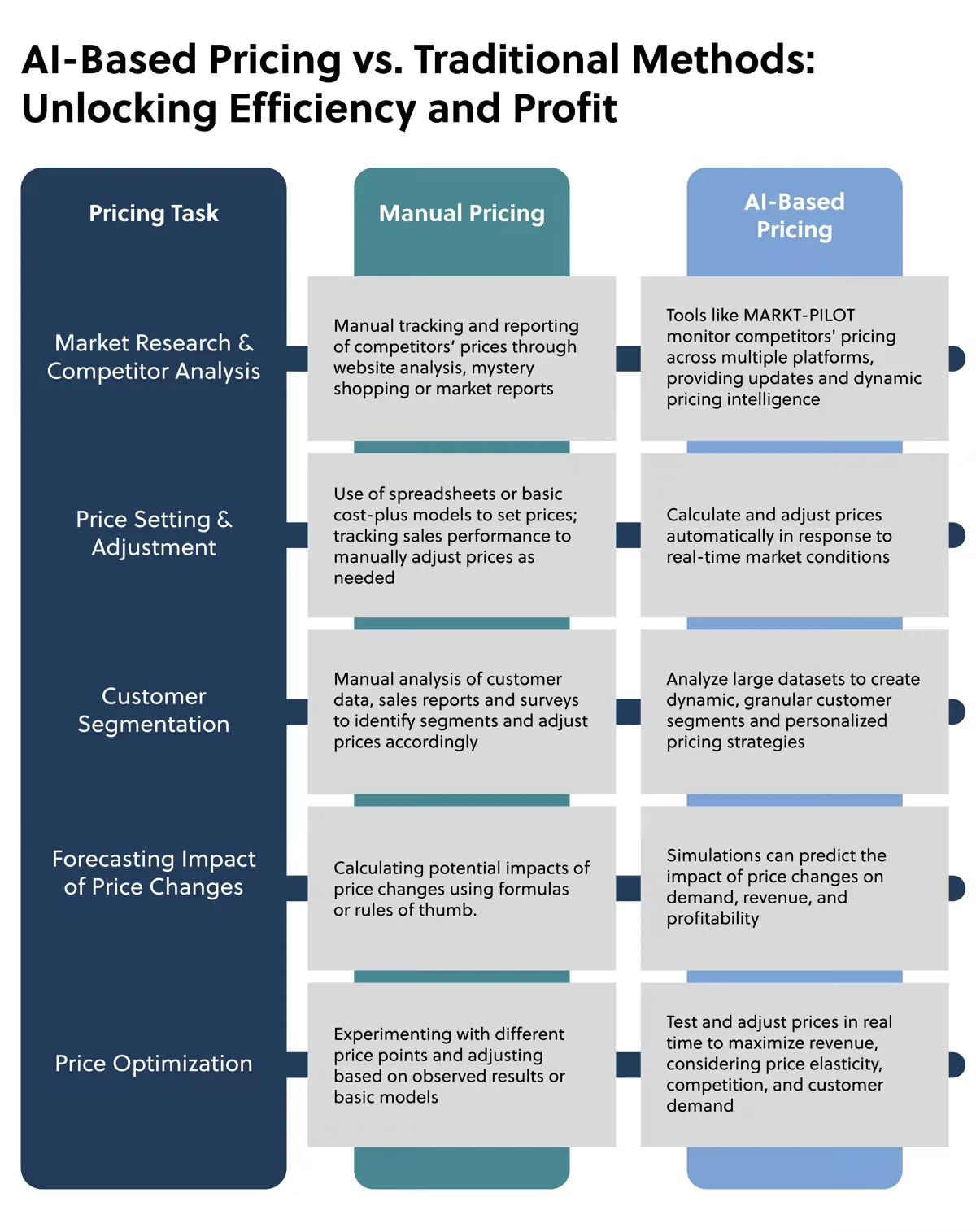
AI-powered pricing tools rely on a combination of data and advanced machine learning algorithms to optimize pricing strategies. These tools are designed to adjust prices based on shifting market conditions, personalized value drivers, competitor movements, and supply-demand dynamics, ensuring that businesses can stay competitive and maximize their revenue. Here’s a closer look at how these systems work:
Data Integration: AI-based pricing tools use web scrapers to gather real-time data from various sources, including competitor websites, marketplaces, price aggregators, ERP systems and market research APIs. For market-based pricing, it’s important to focus on competitor pricing, supply-demand factors, and market conditions.
Web scrapers are tools used to extract data from websites. Using predefined parameters, they navigate through web pages, identifying specific elements such as prices, product descriptions and competitor listings. The data they collect is then fed into the AI pricing system for analysis.
AI and Machine Learning: AI is used to analyze the collected data and predict the best pricing strategies. AI-powered tools can adjust prices automatically when competitors change their prices, or when demand for a specific machine or part increases. Depending on the type of data that the system has access to, it can also carry out personalized pricing, demand forecasting and quotation optimization.
Ongoing Adjustments: AI continuously monitors market conditions. Whether it’s increasing prices when demand surges or lowering them when competition intensifies, the system ensures that pricing decisions are aligned with the latest market conditions.
While AI pricing tools are highly effective, they don’t operate in isolation. Humans play an essential role in setting boundaries, fine-tuning models, handling exceptions, ensuring ethical pricing, and aligning strategies with broader business goals. Working with AI pricing systems is a collaborative endeavor, where AI provides dynamic, data-driven pricing suggestions and humans ensure that those suggestions align with the company’s objectives. Combining AI efficiency with human oversight ensures that pricing remains competitive and strategically sound.