
Event
Built to Lead: What Aftermarket Leadership Looks Like in Practice
How Siemens Energy, Terex, CLAAS and other manufacturers price, sell and plan in the aftermarket. Insights from PARTS SUMMIT 2026 in Frankfurt.
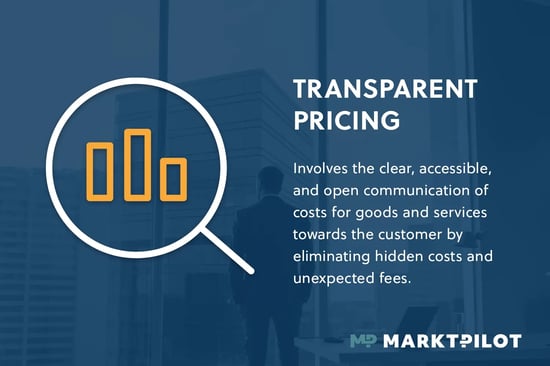
Transparent pricing, also known as price transparency, involves the clear, accessible, and open communication of costs for goods and services. This approach allows customers to easily comprehend the total amount they will pay and the reasons behind it, enabling them to make informed decisions and compare options across different providers. Such transparency fosters trust between businesses and consumers by eliminating hidden costs and unexpected fees.
By adopting transparent pricing, companies not only showcase fairness and integrity but also enhance their competitive advantage. In many instances, increased price transparency boosts market efficiency, resulting in reduced prices, heightened customer satisfaction, and improved overall value.
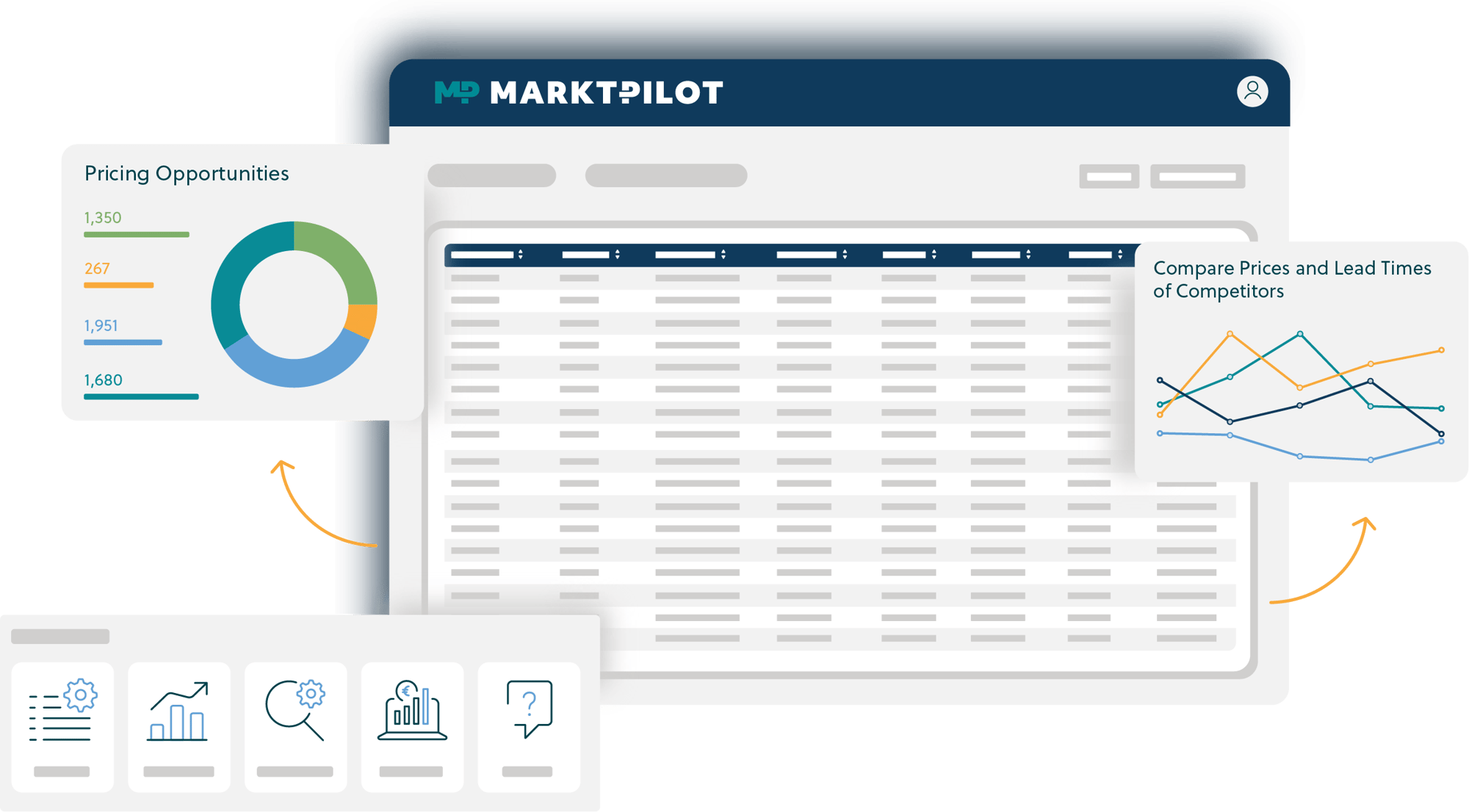
Most pricing teams know how they should price. The method is written down, with different rules for captive parts, competitive parts and the long tail. In practice the portfolio still runs on one multiplier, because nothing in place can execute the strategy.
One rule for every part is drift by default. A part only you sell is priced like a part six suppliers sell, one ends up too cheap and the other too expensive, and the two errors offset in the reported margin so neither shows. MP ONE™ turns the written strategy into governed rules by segment, with market data to show which segments to split first. Performance is tracked segment by segment, so the first split builds the case for the next.
Running pricing this way is what we call Pricing Performance.
The concept of transparent pricing has gained traction across various industries, from healthcare to e-commerce, as consumers demand greater clarity and honesty. In healthcare, for example, transparent pricing allows patients to understand the cost of medical services and procedures before receiving care, which can lead to more informed choices and potentially lower expenses. Similarly, in the e-commerce sector, businesses that clearly outline product prices, shipping costs, and additional fees are more likely to build consumer trust and loyalty.
Clear pricing is key to informed decision making. When consumers know the full cost of a product or service, including base price, add-ons and discounts, they can compare options and choose the best for them. Transparent pricing eliminates hidden costs and surprise bills and feels fair and clear.
For businesses, providing this level of pricing information builds trust and improves the overall customer experience, but it also has strategic benefits. Transparency forces companies to be more deliberate and data driven in their pricing. In competitive markets, companies should do benchmarking against their competitors and refine their value proposition.
Transparent pricing can be a price optimization catalyst. By openly aligning prices to customer expectations and market reality companies can identify where they are undercharging, or where they can improve margins without losing competitiveness. Price transparency is crucial because understanding what others are bidding, asking, and trading provides insight into the supply and demand dynamics of a security, good, or service. Ultimately transparent pricing supports better customer decisions and smarter more competitive pricing for businesses.
Integrating price transparency into a company's business model is not just a strategic move but an essential part of doing business fairly and honestly. It's a commitment to fairness, honesty and customer-centric values. Adopting this approach is important to building stronger relationships with customers and standing out in a crowded marketplace. Transparent pricing appeals to today's consumers, who increasingly expect clarity and openness when making purchasing decisions.
To implement price transparency effectively, companies must provide detailed and accessible information about their pricing structures. This means disclosing not only base prices, but also any additional fees, discounts, and cost breakdowns. Transparency must be communicated through multiple channels, such as websites, customer service interactions, and marketing materials. For example, a company should offer an online pricing page that clearly outlines the total cost of a product or service, including all applicable fees, so customers can make informed choices without surprises.
By embracing transparent pricing, businesses demonstrate accountability, gain a competitive advantage, and strengthen customer trust and long-term loyalty.
In e-commerce transparency of pricing is necessary for building trust and customer satisfaction. When customers can see what they’re paying for, including the full product price, shipping fees and any additional charges, they’ll feel more confident in their purchase and come back for more.
For example an e-commerce business might show the product price and shipping costs and taxes before the final step in the purchase process. This level of price transparency not only makes for a better shopping experience but also looks fair and helps build long term customer loyalty and a healthier more honest market.
An excellent illustration of price transparency can be found in software-as-a-service (SaaS) companies such as Slack or Dropbox. On their pricing pages, these companies present a detailed breakdown of each pricing tier and their pricing information, often including both monthly and annual rates, feature sets, user limits, and any additional costs.
For example, Dropbox displays its various subscription plans side by side, clearly indicating what users receive at each level (e.g., storage capacity, number of users, support level) along with the associated costs. Taxes and any applicable overage fees are also transparently communicated before purchase. This level of transparency enables customers to easily compare plans, understand what they are paying for, and avoid unexpected fees, which builds trust and reduces purchase hesitation.
AI-driven market research streamlines the analysis of large datasets, such as competitor pricing, customer trends, and material costs. By automating repetitive tasks, it not only saves time but also delivers greater accuracy than common manual methods. This approach is particularly relevant to machine manufacturers aiming for market-based pricing strategies.
In machine manufacturing, price transparency is essential for building trust and staying competitive. Historically, the business model of manufacturers has focused on internal cost structures (materials, labor and overhead) as the basis for a cost-plus pricing strategy. By sharing these cost components with the customer, they help the customer understand the true value of their products and make informed decisions and compare offers. This kind of transparency builds customer relationships and a company’s reputation for fairness and reliability.
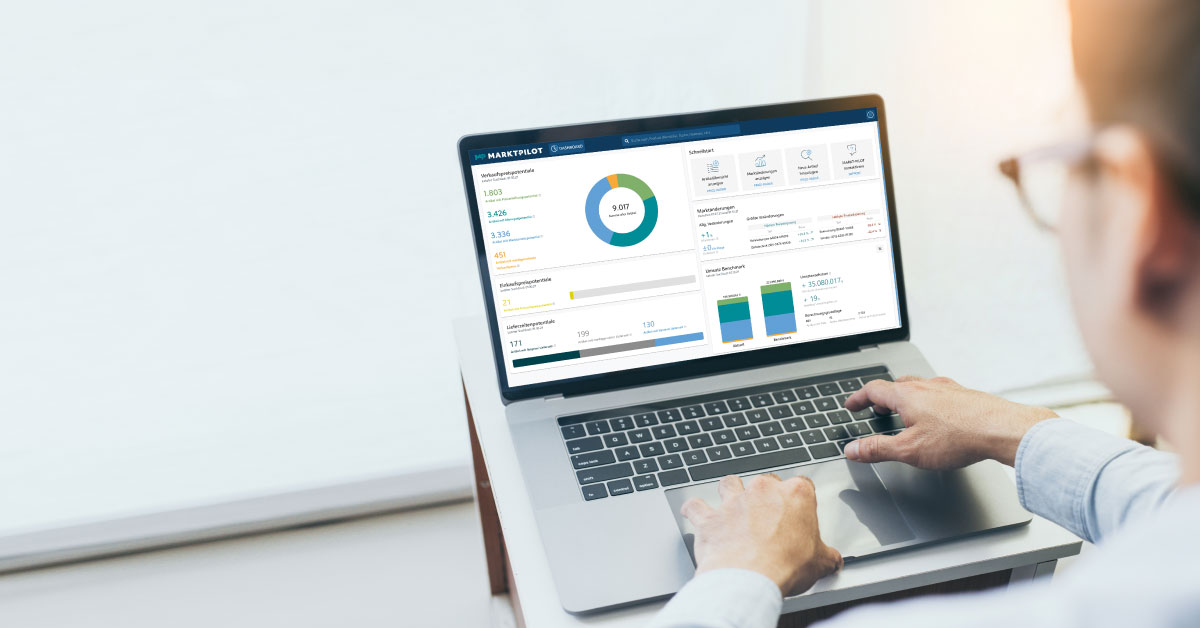
But price transparency in this industry is not just about customer-facing honesty. It’s also about getting visibility into the broader market and optimizing pricing strategies beyond simple cost-plus. As global competition increases and customers become more price aware, manufacturers need to know how their pricing compares to the competition. Market-based pricing, where decisions are driven by real-time AI-powered market intelligence, pricing software and competitive benchmarks, enables manufacturers to price dynamically and stay competitive.
By combining internal transparency and external market insight, machine manufacturers can position themselves as modern data driven businesses. This dual approach attracts price conscious customers and gives manufacturers the strategic knowledge to compete and sustain in a volatile market.
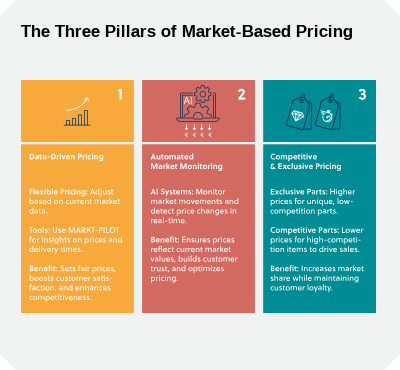
Overview of Parts Pricing Strategies
In this article, we review a few of the most common parts pricing strategies for OEMs.
For more information about how a market-based pricing strategy supported by MP ONE, the unified Pricing Performance platform, can create higher price transparency in machine manufacturing, contact our experts and explore solutions for your business.
How current, controlled and proven is your pricing today? Take the Pricing Performance self-assessment.

Price intelligence empowers machine manufacturers with strategic insights to optimize parts pricing in a dynamic market.
Learn more about the benefits of market-based pricing, and easy steps to implement a competitive pricing strategy.
Innovative pricing strategies in the spare parts business keep profitability, sales and customer satisfaction in balance.
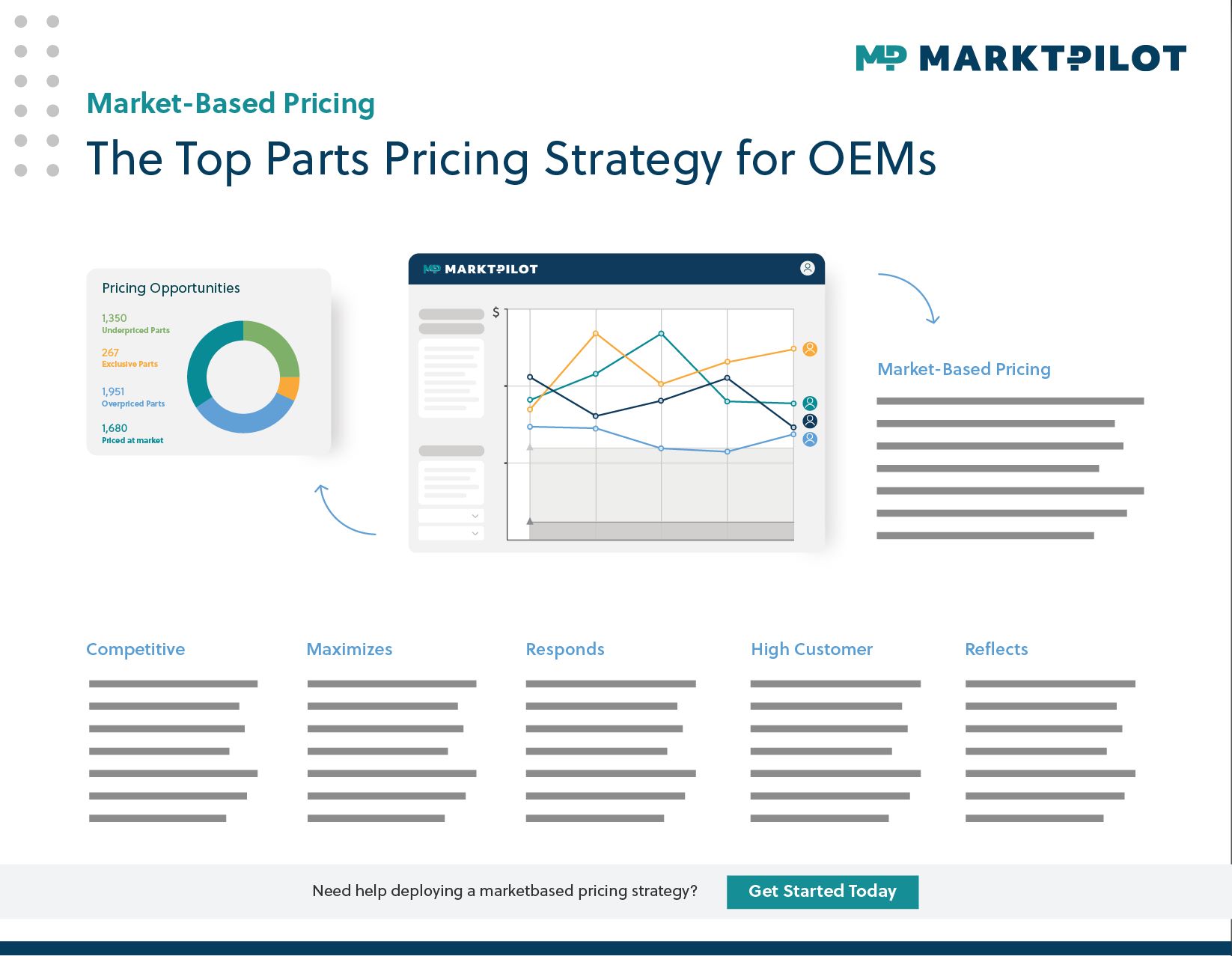
Take a deep dive into what is the top pricing strategy for OEMs and discover how it can greatly increase your revenue.
How Siemens Energy, Terex, CLAAS and other manufacturers price, sell and plan in the aftermarket. Insights from PARTS SUMMIT 2026 in Frankfurt.
MARKT-PILOT™ Co-CEO Stephen Fauth on the PIE-Cast: why domain expertise is no longer enough, how to disrupt yourself first, what the future of...
PARTS FORUM 2026 brought aftermarket leaders to Chicago for a record-breaking day on pricing, strategy, and industry transformation. Here’s the...